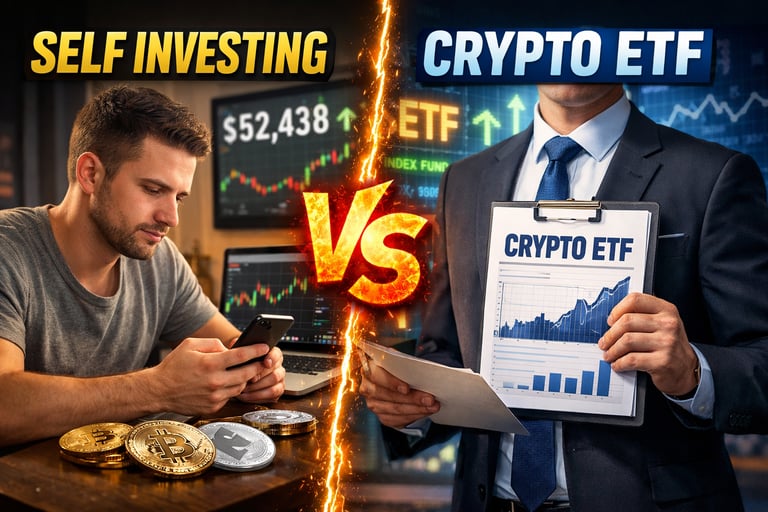
Crypto ETF vs Self Buying in 2026: Smart Investors Are Choosing THIS Strategy | DropFinder
Crypto ETF vs self buying crypto in 2026 explained in depth. Learn which crypto investment strategy delivers higher long-term returns, better security, lower risk, and smarter tax efficiency. This complete DropFinder guide helps investors decide whether Bitcoin and crypto ETFs are safer than buying and holding crypto directly in wallets, with practical insights for beginners and experienced investors planning wealth creation in 2026 and beyond.
CRYPTO NEWS
12/29/20255 min read
Introduction: Why This Decision Matters More Than Ever in 2026
By 2026, cryptocurrency has firmly entered the global financial system. What was once considered a risky and speculative asset class is now discussed alongside equities, bonds, and commodities. Governments regulate it, institutions hold it, and retail investors actively allocate capital to it.
Yet despite this maturity, one question still divides investors:
Should you invest in crypto through ETFs, or should you buy and hold crypto yourself?
This is not a small decision. The choice you make affects your long-term returns, ownership rights, taxation, flexibility, and even your psychological comfort during volatile markets.
This in-depth DropFinder analysis breaks down both options in a clear, realistic, and future-focused manner so you can choose the right strategy for 2026 and the coming decade.
Understanding the Evolution of Crypto Investing
In the early years, self custody was the only option. Investors had to manage wallets, private keys, backups, and security risks on their own. As adoption grew, exchanges became more user-friendly, but regulatory uncertainty remained high.
The introduction of crypto ETFs changed everything. They allowed traditional investors to participate without touching blockchain technology. This attracted institutional capital, pension funds, and conservative investors who previously stayed away from crypto.
In 2026, both models coexist. Neither is obsolete. The key is understanding what each one is truly designed for.
What Is a Crypto ETF and How It Works in 2026
A Crypto ETF is a regulated financial product that tracks the price of a cryptocurrency such as Bitcoin or Ethereum. Investors buy shares of the ETF through a stockbroker, just like they would buy shares of a company.
The ETF provider handles custody, security, compliance, and reporting. The investor simply holds units of the fund.
In practical terms, a crypto ETF removes every technical aspect of crypto ownership. There are no wallets, no seed phrases, no gas fees, and no on-chain transactions.
For many people, this simplicity is the biggest attraction.
What Does Self Buying Crypto Really Mean Today?
Self buying crypto means purchasing digital assets directly from a crypto exchange and holding them under your control. This can be done by keeping funds on an exchange, using a software wallet, or securing them in a hardware wallet.
In this model, you own the actual asset, not a representation of it. You control when and how it is used. You can transfer it, stake it, lend it, or interact with decentralized applications.
Self buying is not just an investment choice. It is participation in the crypto ecosystem itself.
Ownership: The Most Important Difference Investors Overlook
The most critical distinction between ETFs and self buying is ownership.
When you invest through a crypto ETF, you do not own Bitcoin or Ethereum. You own a financial instrument whose value depends on those assets. You cannot withdraw the crypto, move it to a wallet, or use it in any ecosystem.
When you buy crypto yourself, you own the asset directly. This ownership is absolute. No intermediary can restrict how you use it, provided you control the private keys.
In 2026, as blockchain-based finance continues to expand, ownership is not just philosophical. It has real financial implications.
Convenience vs Control: A Strategic Trade-Off
Crypto ETFs are built for convenience. They eliminate technical barriers and reduce user error. For many investors, this lowers stress and increases confidence.
Self buying is built for control. It gives you flexibility and optionality but requires education, discipline, and security awareness.
Neither approach is objectively better in isolation. The better option depends on whether you prioritize ease or autonomy.
Security Considerations in 2026
Security is often cited as a reason to prefer ETFs. ETF assets are typically held by institutional custodians using advanced security infrastructure. For investors uncomfortable managing keys, this can feel safer.
However, self custody has evolved significantly. Hardware wallets, multisignature setups, and better education have reduced risks dramatically for disciplined users.
In reality, most losses still occur due to poor practices, not inherent flaws in self custody.
By 2026, security is less about the tool and more about the user’s behavior.
Fees and Long-Term Cost Impact
Crypto ETFs charge management fees. These fees may appear small annually, but over long periods they compound and reduce total returns.
Self buying involves transaction fees and network fees, but once assets are held, there are no ongoing management costs.
For long-term investors holding assets for many years, fee drag can become significant.
This is one reason experienced investors often prefer direct ownership despite the added responsibility.
Returns: Why the Numbers Can Differ Over Time
At first glance, ETF returns mirror crypto prices. Over short periods, the difference may be negligible.
Over long periods, however, ETFs often underperform due to fees, tracking errors, and structural inefficiencies.
Self buyers can enhance returns through staking, yield generation, and participation in ecosystem incentives. These additional income streams are completely unavailable to ETF investors.
In 2026, when yield opportunities are more mature and regulated, this gap becomes even more pronounced.
Liquidity and Market Access
Crypto markets operate 24/7. Self buyers can react instantly to global events, volatility, or opportunities.
ETFs trade only during stock market hours. In highly volatile markets, this limitation can create gaps and delayed reactions.
For long-term holders, this may not matter. For active or opportunistic investors, it can be decisive.
Taxation Reality in 2026
Taxation is one area where ETFs have a clear advantage.
ETF transactions usually follow traditional capital market tax rules, which are simpler and better understood by tax authorities.
Self buying crypto can involve complex tax events, especially when staking, trading, or interacting with decentralized platforms.
Investors who value simplicity and compliance may prefer ETFs purely for this reason.
Psychological Comfort and Behavioral Factors
Investing is not purely mathematical. Human psychology plays a major role.
ETFs feel familiar. They fit into existing portfolios and reporting systems. This familiarity reduces emotional stress during market swings.
Self custody requires conviction. Price volatility feels more intense when you directly own the asset and see it fluctuate in real time.
Ironically, this discomfort often leads to better long-term discipline for those who truly believe in the asset.
Institutional vs Individual Mindset
Crypto ETFs are designed primarily for institutions, retirement accounts, and conservative investors.
Self buying is designed for individuals who want direct exposure and participation.
Understanding which category you belong to is essential before making a choice.
The Hybrid Strategy: What Smart Investors Are Doing in 2026
Many experienced investors do not treat this as an either-or decision.
They allocate part of their capital to ETFs for regulatory comfort and stability, and another part to self custody for growth and innovation.
This hybrid approach balances security, compliance, and upside potential.
DropFinder considers this one of the most resilient strategies for 2026.
Who Should Choose Crypto ETFs in 2026
Crypto ETFs are ideal for investors who want exposure without complexity. They suit long-term passive investors, retirees, and those integrating crypto into traditional portfolios.
If you do not want to manage wallets or track technical developments, ETFs provide a clean solution.
Who Should Choose Self Buying Crypto in 2026
Self buying is best for investors who believe in the long-term transformation crypto represents.
If you value ownership, flexibility, and maximum return potential, direct crypto ownership aligns better with your goals.
Education and discipline are required, but the rewards can be substantial.
Final Verdict: DropFinder’s 2026 Recommendation
Crypto ETFs and self buying serve different purposes. One offers simplicity and regulation. The other offers ownership and opportunity.
In 2026, the smartest investors are not asking which one is better universally. They are asking which one is better for their specific goals.
DropFinder’s conclusion is clear:
If you want ease, choose exposure.
If you want ownership, choose self custody.
If you want balance, combine both.
The future of crypto investing is not about choosing sides. It is about choosing strategy.