Crypto Exchange Fees Explained What Most Users Don’t Understand
Crypto exchange fees can quietly reduce your profits. Learn how trading fees, hidden costs, and spreads work so you stop losing money without realizing it.
CRYPTO NEWS
3/22/20263 min read
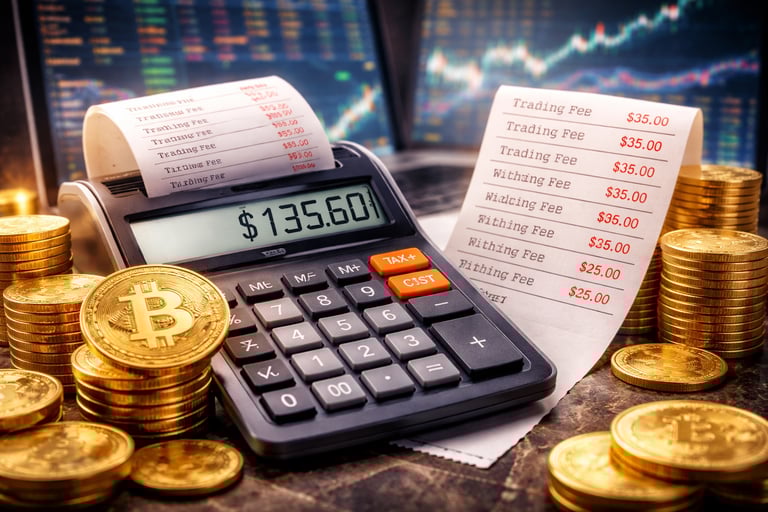
The Hidden Cost That Slowly Drains Your Crypto Profits
Most traders think losses come from bad trades.
But a large part of your loss comes from something invisible.
Fees.
They are small per transaction.
But they repeat constantly.
For example.
If you trade $1000 with a 0.1 percent fee, you pay $1 per trade.
If you make 5 trades per day, that is $5 daily.
That becomes around $150 per month.
Most users never calculate this.
And that is where silent losses begin.
Why Fees Matter More Than Your Strategy
Beginners focus on profit.
Smart traders focus on cost.
Because even a profitable strategy can fail if fees are too high.
For example.
Trader A earns 5 percent monthly but pays 1 percent in fees.
Trader B earns 4 percent but pays only 0.2 percent in fees.
Over time, Trader B keeps more profit.
Fees directly affect your net outcome.
The Three Main Types of Exchange Fees
Trading Fees
Most major exchanges charge between 0.1 percent to 0.2 percent per trade.
Some examples:
Binance spot fee ~0.1 percent
Bybit spot fee ~0.1 percent
MEXC often offers 0 percent on selected pairs
Now here is what most users miss.
There are two types:
Maker fee
Taker fee
Taker fees are usually higher.
And most beginners use market orders, which means they always pay higher fees.
Withdrawal Fees
This is where many users get surprised.
Example:
Bitcoin withdrawal can range from $2 to $15 depending on network and platform.
Ethereum withdrawals can be even higher during congestion.
Some exchanges appear cheap but charge heavily when you withdraw.
If you move funds frequently, this becomes a major cost.
Spread The Hidden Cost
Spread is often more expensive than trading fees.
Example.
You buy Bitcoin at $100,000.
But due to spread, you actually pay $100,200.
That $200 difference is hidden cost.
Many “zero fee” platforms make money mainly from spread.
This is why zero fee does not mean zero cost.
The Biggest Mistake Beginners Make
Most beginners only compare trading fees.
They ignore:
Spread
Withdrawal cost
Liquidity
This leads to choosing the wrong platform.
An exchange with 0 percent fees but high spread can cost more than one with 0.1 percent fees.
Why “Zero Fee” Exchanges Are Not Truly Free
When an exchange offers zero fees, it recovers money through:
Higher spread
Limited price execution
Hidden charges
For example.
If spread is 0.3 percent instead of 0.1 percent, you are paying more than a normal exchange.
But you do not see it directly.
That is why many beginners get misled.
How Fees Affect Long Term Growth
Let’s take a simple scenario.
Initial capital = $1000
Monthly trading return = 5 percent
Without fees:
After 1 year ≈ $1795
With 1 percent total monthly fees:
After 1 year ≈ $1550
That is a difference of $245.
And this gap increases with larger capital.
Fees reduce compounding power.
How to Reduce Fees Smartly
Use Limit Orders
Limit orders often qualify for maker fees.
This reduces cost compared to market orders.
Choose High Liquidity Exchanges
High liquidity reduces spread.
This gives better execution and lower hidden cost.
Avoid Overtrading
Every trade costs money.
More trades do not always mean more profit.
Smart traders trade less but better.
Use Exchange Token Discounts
Many exchanges offer 10–25 percent fee discounts if you use their native token.
This can significantly reduce long-term cost.
What Most People Don’t Realize
Most users think trading fees are the biggest cost.
But in reality:
Spread + bad execution often costs more than fees.
This is why two traders using different exchanges get different results even with the same strategy.
What Smart Traders Do Differently
They do not just trade.
They optimize.
They:
Track fee percentage
Compare platforms
Reduce unnecessary trades
They understand one thing.
Profit is not just about winning trades.
It is about keeping what you earn.
A Simple Rule That Changes Everything
Before placing a trade, ask:
“How much will this cost me”
Not just in fees.
But in spread and execution.
That one habit separates beginners from serious traders.
Conclusion
Crypto exchange fees are not small details.
They are a major factor in your success.
Ignoring them leads to silent losses.
Understanding them gives you an edge.
Because in crypto, the difference between average and profitable traders is often not strategy.
It is cost control.