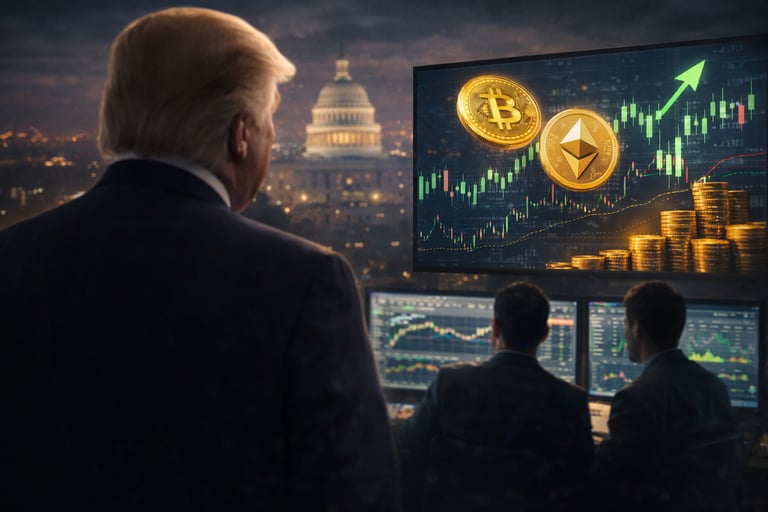
Did Donald Trump Secretly Influence the Crypto Market for Personal Gain? What Investors Need to Know
Did Donald Trump manipulate crypto prices for personal benefit? Here’s what the evidence shows, what’s speculation, and what investors should understand.
CRYPTO NEWS
2/11/20263 min read
When Politics Meets Bitcoin: Power, Influence, and the Crypto Question
Cryptocurrency markets thrive on momentum, narrative, and perception. A single regulatory hint or political remark can trigger billions of dollars in trading volume within hours. That’s why an increasingly common question has surfaced among investors:
Did Donald Trump influence crypto markets in ways that may have benefited him personally?
It’s a provocative claim. But markets demand evidence, not assumptions. To evaluate this question responsibly, we need to separate emotion from economic mechanics.
Why Political Figures Can Move Crypto Prices
Cryptocurrencies such as Bitcoin operate differently from traditional equities. Unlike stocks, which are tied to earnings and cash flow, crypto assets are largely driven by:
Sentiment
Regulatory expectations
Liquidity conditions
Institutional adoption
Global macro policy
Political leaders shape regulatory tone and fiscal policy. Even indirect commentary can influence investor expectations. In highly speculative markets, expectations alone can move price.
But price reaction does not automatically imply manipulation.
Influence vs Manipulation: Understanding the Legal Line
The term “market manipulation” has a specific legal meaning. It typically involves:
Intentional dissemination of false information
Coordinated schemes to distort price
Insider trading using non-public material information
Artificial interference in supply or demand
For an accusation of manipulation to hold weight, there must be demonstrable evidence of intent and benefit.
Public statements — even controversial ones — are not inherently illegal. Politicians regularly comment on economic policy, and markets often react. That dynamic is common across equities, bonds, commodities, and crypto.
Trump’s Public Stance on Cryptocurrency
During his presidency, Donald Trump publicly expressed skepticism toward cryptocurrencies. At various times, he emphasized support for the U.S. dollar and questioned the volatility of digital assets.
Later political discourse around digital assets evolved nationwide as crypto adoption expanded and regulatory discussions intensified.
Public commentary from political figures often impacts markets because investors attempt to anticipate:
Future regulation
Tax policy
Institutional acceptance
Monetary direction
That anticipation creates volatility — but volatility alone is not proof of orchestration.
Why Speculation Persists
Three factors fuel suspicion around political influence in crypto markets:
1. Extreme Volatility
Crypto prices can move 5–20% in a single day. When movements coincide with political developments, it is easy to assume causation.
2. Narrative-Driven Trading
Crypto markets often trade on stories — ETF approvals, regulation fears, institutional entry, or macro shifts. Political narratives integrate quickly into those stories.
3. Social Media Amplification
Online discussions magnify correlations, sometimes without full context. Viral timelines can create the impression of coordinated strategy where none may exist.
In high-volatility markets, timing can appear intentional even if it is coincidental.
Is There Evidence of Personal Financial Gain?
As of publicly available records and verified reporting, there is no confirmed legal finding demonstrating that Donald Trump manipulated crypto markets for personal enrichment.
It is important to avoid conflating:
Market sensitivity to political power
Strategic public messaging
Coordinated, unlawful price interference
Without documented proof of direct financial positioning aligned with deliberate price-moving actions, claims remain speculative.
How Political Signals Typically Impact Crypto
Crypto markets respond to macroeconomic and policy shifts such as:
Interest rate expectations
Taxation frameworks
Regulatory clarity
Institutional investment approval
Political leaders influence these macro narratives. Investors attempt to front-run potential regulatory outcomes. That forward-looking behavior can cause dramatic price swings.
However, long-term crypto cycles are usually influenced more heavily by:
Global liquidity
Institutional adoption
Technological upgrades
Market-wide leverage
Political commentary tends to affect short-term volatility more than structural trends.
The Retail Investor Angle
Retail traders are often the most emotionally reactive participants in crypto markets. News-driven spikes frequently attract late entries fueled by:
Fear of missing out (FOMO)
Algorithmic trading reactions
Momentum chasing
When reversals occur, those same traders absorb outsized losses.
Blaming a single political figure can oversimplify a market ecosystem powered by global liquidity and decentralized participation.
The Bigger Question: Transparency and Regulation
While no verified evidence supports claims of manipulation, the broader discussion raises legitimate governance concerns:
Should public officials disclose digital asset holdings?
Should clearer guidelines exist regarding political communication and financial markets?
How should global crypto regulation evolve?
As digital assets become more mainstream, expectations around transparency will likely increase.
The Structural Reality of Crypto Markets
Cryptocurrency markets are global and decentralized. Liquidity flows through:
International exchanges
Institutional trading desks
Hedge funds
Retail platforms
Algorithmic systems
No single individual controls these flows.
Short-term influence is possible. Long-term control is far less plausible in a distributed financial system spanning continents and time zones.
Final Assessment
Did Donald Trump secretly influence the crypto market for personal gain?
Based on currently available public evidence, there is no verified proof of deliberate market manipulation for personal benefit.
Crypto markets are highly sensitive to political narratives. That sensitivity reflects investor psychology — not necessarily coordinated control.
For disciplined investors, the key takeaway is clear:
Focus on liquidity cycles, regulatory clarity, and macroeconomic conditions — not speculation-driven headlines.
Because in crypto markets, narratives can move prices for days.
But fundamentals and liquidity ultimately define long-term outcomes.