DropFinder Analysis – Staking vs Providing Liquidity: Which Is Better for Higher Returns in 2026
DropFinder Research compares staking vs providing liquidity in 2026 to determine which earns higher returns. Explore APY, risks, DeFi pools, LST/LRT yield farming, restaking, and advanced strategies to maximize crypto income..
CRYPTO NEWS
12/2/20255 min read
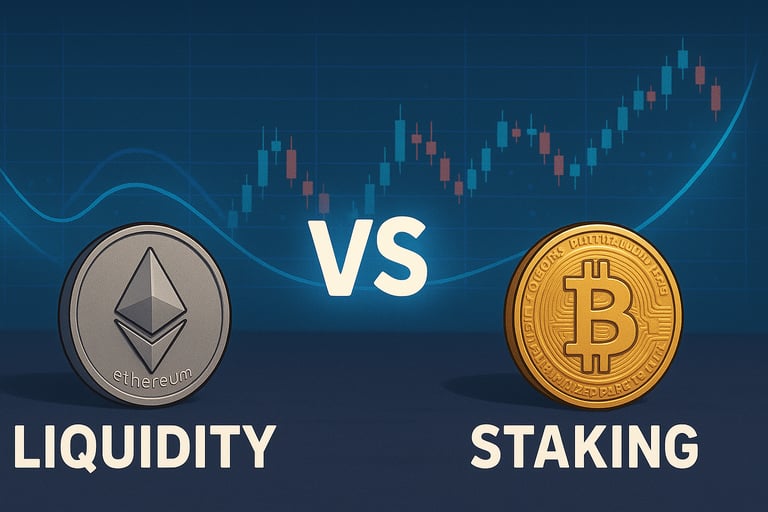
Staking vs Providing Liquidity: Which Is Better for Higher Returns in 2026
Crypto investors in 2026 have two main ways to earn passive income: staking and providing liquidity. Both are powerful, both are profitable, and both are must-know techniques for anyone serious about earning in DeFi. But which one actually gives higher returns? And which one is safer? And which one should you use depending on your risk profile?
This DropFinder deep-dive reveals the full picture, explaining how staking works in 2026, how liquidity provision has evolved, the real APY ranges you can expect, and which choice is better for high yield.
Understanding Staking in 2026
Staking is the easiest and most stable way to earn crypto rewards. It involves locking your tokens into a blockchain validator or staking protocol to secure the network. Staking used to be simple, giving only 4–10% APR. But by 2026, staking has advanced greatly thanks to liquid staking tokens and restaking protocols.
Liquid staking tokens (LSTs) let you stake assets like ETH or SOL while staying liquid. Examples include stETH, rETH, swETH, mSOL, JitoSOL and others. These earn staking rewards passively while allowing you to use them in DeFi.
Liquid restaking tokens (LRTs) go even further. Tokens like weETH, ezETH, rsETH and pufETH let you earn not just staking rewards but also restaking rewards from EigenLayer-style platforms. Restaking became the biggest income narrative of 2025–26, allowing users to earn multiple layers of yield at the same time.
With staking alone, the typical base rewards in 2026 look like this: standard blockchain staking gives around 4–10 percent, liquid staking through LSTs yields 6–12 percent, LRT restaking can offer 10–80 percent, and when combined with DeFi farming and seasonal incentives, staking-based APY can reach 20–200 percent.
The returns are predictable, the risk is moderate, and staking is ideal for those who want passive income without constantly monitoring positions.
Understanding Liquidity Provision in 2026
Providing liquidity is entirely different. Instead of securing a network, you deposit tokens into a trading pool or lending platform. This helps other users trade, borrow or swap tokens, and you earn part of the fees or incentives.
Liquidity pools in 2026 come in several forms. There are AMM pools on DEXs such as Uniswap, Orca, Raydium and PancakeSwap. There are concentrated liquidity pools. There are stablecoin pools like USDC/USDT pairs. There are volatile pairs like BTC/ETH or SOL/USDC. There are also LST and LRT pools where tokens like stETH or weETH are paired with ETH.
Liquidity provisioning can also be done in lending platforms like Aave, Compound or MarginFi, where you supply tokens into lending pools and earn yield from borrowers.
The return potential for liquidity providers is extremely high in 2026. Stablecoin pools can offer 5–25 percent, blue-chip volatile pairs can earn 10–60 percent, LST and LRT pools can pay 20–300 percent, while incentivized yield farms during their launch phases can generate 50–800 percent or more. Early pools on new Layer-2 chains sometimes hit 100–1000 percent APY before rewards normalize.
Liquidity provision can clearly earn far more than staking, but it also carries higher risks.
Return Comparison Between Staking and Liquidity Provision
When comparing the return potential of staking against liquidity provision, liquidity provision clearly wins for maximum APY potential. Staking usually ranges from low single digits up to 200 percent if combined with LRT and boosted rewards. Liquidity provision ranges from 5 percent to several hundred percent and can even reach a thousand percent during peak incentive periods.
However, staking is more stable, while liquidity provision fluctuates heavily depending on token volatility, market demand, pool incentives and overall liquidity conditions.
Both methods can give airdrops, but liquidity providers often receive more airdrop eligibility because protocols reward LP users heavily for driving liquidity into their ecosystems.
Which Is Better for High Returns in 2026
If your main goal is high returns, liquidity provision is the superior choice. LPing with LRT or LST pairs in top pools can deliver explosive APY, especially during new project launches, boosted farming seasons or L2 expansions.
Liquidity pools on platforms like Kamino, Orca, Raydium, Maverick and Pendle consistently provide higher yields than standard staking. LRT pools for tokens like weETH, ezETH, rsETH or JitoSOL often pay the highest yields in the entire crypto market.
Staking, while profitable, rarely reaches the dramatic upside found in liquidity farming. Staking is superior for stable, predictable returns, while liquidity provision is superior for high-risk, high-reward strategies.
Why Staking Is Still Extremely Valuable
Despite not offering the highest APY, staking remains one of the most important and profitable ways to earn. It is significantly safer than LPing. It avoids impermanent loss, which is the biggest risk of liquidity provision. Stakers do not suffer from token imbalance or trading volatility affecting their deposits.
Staking stands out because it is simple, predictable, low-maintenance and ideal for long-term holding. Restaking and LRT ecosystems have made staking even more powerful. Now users can earn:
staking rewards
restaking rewards
DeFi farming rewards
points for airdrops
partner incentives
This multi-layer income structure makes staking attractive for beginners and long-term investors.
Why Providing Liquidity Can Be Extremely Profitable
Liquidity provision is the highest earning method in DeFi. It offers massive upside because LPs earn from multiple reward channels such as swap fees, platform token incentives, farming bonuses, LST/LRT rewards and seasonal boosts. During incentive cycles, liquidity providers can earn extraordinary APY that staking alone can never match.
LPing also gives very high airdrop eligibility. New blockchains and protocols encourage liquidity by rewarding LPs with points that later convert into large airdrops. This makes LPing attractive for professional yield farmers.
Liquidity provision is also highly flexible. You can choose pools based on your risk appetite, whether stable pools for lower risk or LST and volatile pools for higher rewards.
Major Risks of Staking
The risks of staking are small but real. There is slashing risk when validators behave incorrectly. There is smart contract risk when using LST or LRT platforms. The reward rate may decrease over time. And prices of the staked token can fall, reducing the value of rewards.
Overall, staking is safer than LPing, but there is still risk.
Major Risks of Providing Liquidity
Liquidity provision carries more significant risks. The biggest one is impermanent loss, a loss caused when the price between the two tokens in a pool changes significantly. If one asset pumps or dumps, the LP position may lose value compared to simply holding the tokens.
LPs face smart contract risk, oracle risk, rugpull risk, and reward token dumping. Highly incentivized pools sometimes pay high APY using tokens that quickly lose value. LPing volatile pairs increases exposure to market swings. Leverage vaults add even more risk.
Because of these factors, LPing requires active management and higher risk tolerance.
Best Method for Long-Term Investors
For long-term investors who want stable income with low effort, staking is undoubtedly the better choice. Liquid staking options such as stETH, rETH, mSOL or JitoSOL offer dependable growth while avoiding the complexity and volatility of LPing.
Best Method for Professional DeFi Farmers
Liquidity provision is the preferred choice for professional DeFi farmers seeking to maximize APY. These users rotate between high-yield pools, monitor incentives, and strategically farm airdrops. They know how to manage impermanent loss and exit pools before rewards collapse.
DeFi farmers consistently earn multiple times more than passive stakers because they take on greater risk and actively optimize positions.
Best High-Return Strategies for 2026
A top strategy for combining stability and high yield is using staked tokens inside liquidity pools. For example, staking ETH to get stETH and then depositing stETH into a stETH/ETH or stETH/USDC liquidity pool gives both staking rewards and LP fees plus farming incentives.
Another powerful strategy is using LRT LP pools: weETH, ezETH, rsETH, pufETH and swETH in boosted pools on Pendle, Maverick or Kamino often generate 50–400 percent APY depending on incentives.
Solana LST pools like JitoSOL or mSOL paired with SOL in Kamino or Orca vaults are also extremely profitable, especially when the Solana ecosystem runs incentive programs.
Stablecoin LPing in USDC/USDT or DAI/USDC pools offers safer returns, often between 20 and 80 percent, without token volatility.
Final DropFinder Summary
Staking is best for safety, stability and long-term passive income. It offers predictable returns and is suitable for beginners and long-term holders. Staking rewards grow significantly when using liquid staking or restaking protocols.
Liquidity provision, on the other hand, is superior for high returns. LPs can earn anywhere from modest fees to explosive 100–400 percent or more during boosted periods. It carries higher risk but also much higher reward.
Both methods have strong roles in 2026, and the best strategy often involves combining them: stake your tokens to get LST or LRT, then use those tokens in carefully chosen liquidity pools for amplified gains.
Final Verdict
For stability and steady growth, choose staking.
For maximum returns and aggressive yield farming, choose liquidity provision.
For the perfect balance of both worlds, use liquid staking tokens inside boosted liquidity pools.