How a U.S. Invasion of Venezuela Could Affect Bitcoin Price in January 2026 | DropFinder Analysis
A U.S. military intervention in Venezuela can move Bitcoin fast through oil shocks, global risk sentiment, sanctions, and USD liquidity. This DropFinder analysis breaks down the most likely January 2026 BTC scenarios, what to watch, and how traders can manage volatility
CRYPTO NEWS
1/3/20264 min read
Why This Topic Matters Right Now: U.S.–Venezuela Conflict and Bitcoin in January 2026
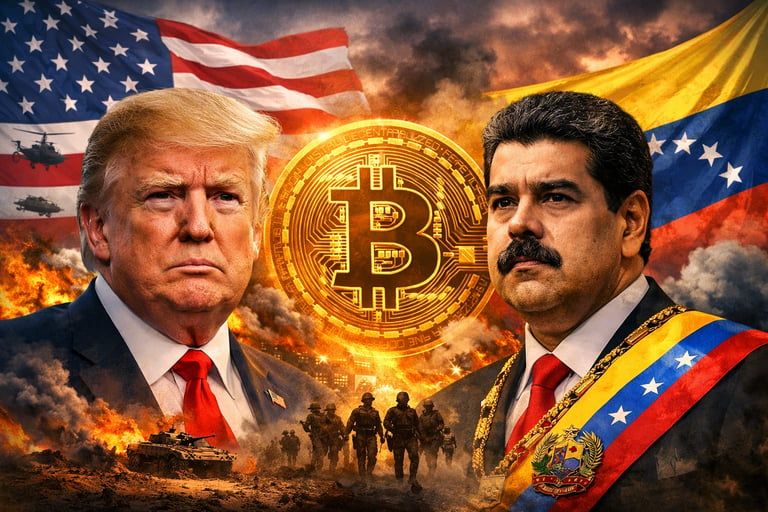
January 2026 has opened with rising geopolitical tension as the United States launches direct military action against Venezuela. Such large-scale geopolitical events are not isolated to politics alone—they ripple across global markets, commodities, currencies, and digital assets.
Bitcoin, in particular, sits at a unique intersection of global finance. Unlike traditional assets, it trades 24/7, reacts instantly to global fear or optimism, and absorbs multiple narratives at the same time.
When geopolitical risk spikes, Bitcoin does not move for just one reason. Instead, it becomes a high-volatility junction point where several market narratives collide simultaneously:
Flight-to-safety narrative (similar to gold)
Risk-asset narrative (similar to tech stocks)
Capital escape narrative (cross-border value transfer)
Liquidity narrative (sensitive to global U.S. dollar conditions)
Because of this, Bitcoin can pump sharply, crash suddenly, or whipsaw violently—often within hours—depending on which narrative dominates the first 24 to 72 hours and which macro forces persist throughout the month.
As of January 3, 2026, Bitcoin is trading near $89,946, placing it at elevated price levels where leverage, derivatives, and liquidation mechanics can significantly amplify volatility.
How the Venezuela Conflict Connects to Bitcoin Price Movements
1. Global Risk Sentiment Drives Bitcoin’s First Move
In the early phase of any military escalation, markets do not react to long-term fundamentals first. They react to positioning and fear.
Traders immediately ask:
Is this conflict contained and short-lived?
Or is it open-ended, escalation-prone, and politically destabilizing?
If markets perceive the conflict as limited, risk appetite often recovers quickly after an initial shock. If the situation appears prolonged or unpredictable, investors reduce exposure to volatile assets.
Bitcoin’s immediate direction depends heavily on:
U.S. stock market behavior
Credit market stress
U.S. dollar demand
Because Bitcoin is highly liquid and trades around the clock, it often becomes the first asset sold during fear spikes, regardless of long-term belief.
January 2026 Implication
Expect:
Elevated intraday volatility
Sudden fakeouts (sharp pumps followed by reversals, or sudden drops followed by rebounds)
Increased liquidation-driven moves during the first week of major headlines
2. Oil Shock and Inflation Expectations: A Delayed but Powerful Effect
Venezuela is a major oil producer. Any military conflict involving energy-rich regions immediately raises concerns about supply disruption, shipping risk, and sanctions.
Oil prices matter to Bitcoin through two competing macro pathways.
Pathway A: Inflation Hedge Narrative (Bitcoin Bullish)
Higher oil prices raise inflation expectations
Real purchasing power of fiat currencies weakens
Investors seek scarce assets
Capital rotates into gold and, in some cases, Bitcoin
Pathway B: Risk-Off and Tight Money Narrative (Bitcoin Bearish)
Higher oil prices worsen inflation fears
Central banks remain hawkish
Interest rates stay higher for longer
Liquidity tightens
Speculative assets, including crypto, face selling pressure
Which pathway dominates depends on whether oil disruptions are viewed as temporary or structurally persistent.
January 2026 Implication
If oil markets reprice meaningfully, Bitcoin may move in two phases:
Immediate risk-off volatility
A delayed inflation-hedge rally—only if liquidity conditions allow
3. U.S. Dollar Strength and Global Liquidity: The Hidden Driver
During geopolitical crises, global capital often rushes into the U.S. dollar for safety and liquidity. A stronger dollar usually places short-term pressure on Bitcoin, which is often treated as a high-beta asset.
However, the story changes if the conflict leads to:
Prolonged sanctions complexity
Capital controls
Banking system disruptions
Declining trust in traditional cross-border payment systems
In such environments, crypto rails gain utility, particularly for cross-border settlement.
January 2026 Implication
If the dominant narrative is “stronger dollar + tighter liquidity,” Bitcoin may struggle.
If the narrative shifts to “financial fragmentation and alternative settlement systems,” Bitcoin can gain strength despite macro stress.
4. Sanctions, Asset Seizures, and the Neutral Money Thesis
Military conflict almost always brings sanctions, asset freezes, and financial enforcement into focus.
This reinforces one of Bitcoin’s core value propositions:
Permissionless
Borderless
Not controlled by any single government
Bitcoin does not rely on correspondent banking systems or political approval to function.
Why This Matters
This does not guarantee immediate price appreciation. However, it can increase medium-term demand from:
Individuals facing currency controls
International merchants experiencing payment friction
Entities seeking neutral settlement assets
January 2026 Implication
If sanctions escalate and financial restrictions become central headlines, crypto usage can rise. Whether Bitcoin benefits directly depends on whether capital flows go into BTC itself or primarily into stablecoins.
5. The Stablecoin-First Reality Most Traders Ignore
A critical mistake many investors make is assuming:
“Geopolitical crisis = Bitcoin instantly explodes upward.”
In reality, stressed environments usually favor stability first.
The typical flow looks like this:
Crisis increases uncertainty
Demand for stablecoins rises
Exchanges rebalance liquidity
Some capital eventually rotates into Bitcoin
Bitcoin is not always the first beneficiary.
January 2026 Implication
Do not expect a straight-line rally. Often the sequence is:
Crisis → Stablecoin demand → Liquidity stabilization → Bitcoin reaction
Three Bitcoin Price Scenarios for January 2026
These are frameworks, not predictions.
Scenario 1: Quick Operation, Limited Escalation
What It Looks Like
Military action ends quickly
Political outcome stabilizes
Oil infrastructure remains intact
Global markets treat the event as contained
Bitcoin Impact
Sharp volatility and liquidation spikes
Followed by recovery if risk assets rebound
Bitcoin may retest or exceed recent highs if liquidity remains supportive
Likely Price Behavior
V-shaped recoveries
Violent wicks
Weekend gaps due to nonstop crypto trading
Scenario 2: Prolonged Intervention and Sanctions Pressure
What It Looks Like
Extended military presence
Cyber disruptions or retaliatory actions
Shipping risk premiums rise
Regional political tension increases
Bitcoin Impact
Sustained risk-off pressure
Rallies sold, dips bought
Inflation hedge narrative competes with liquidity tightening
Likely Price Behavior
Wide trading ranges
Large daily candles
No clear trend until macro clarity improves
Scenario 3: Regional Spillover and Broader Geopolitical Stress
What It Looks Like
Border instability
Diplomatic escalation
Global powers increase economic pressure
Markets price a wider geopolitical risk premium
Bitcoin Impact
Higher probability of deeper drawdowns during risk-off waves
Potential long-term outperformance if trust in traditional systems erodes
Likely Price Behavior
Strong correlation with macro assets
More trend days
Sharp funding rate swings
What Bitcoin Traders Should Monitor in January 2026
1. Oil and Energy Headlines
Oil is the fastest transmission channel from Venezuela to global macro markets. Watch for:
Export disruption language
Port and tanker restrictions
Sanctions expansion
If oil remains calm, Bitcoin reacts mostly to sentiment. If oil reprices, Bitcoin reacts for macro reasons.
2. U.S. Dollar and Real Yields
Rising dollar and yields → headwind for Bitcoin
Falling yields on growth fears → potential Bitcoin relief rallies
Bitcoin often reacts to second-order effects, not the headline itself.
3. Crypto Market Microstructure
During high-stress periods, internal crypto mechanics matter more:
Liquidation clusters
Funding rate extremes
Exchange instability
Regional stablecoin premiums
These factors often create overshoots followed by sharp reversals.
4. Policy and Regulatory Messaging
Sanctions and enforcement can temporarily hurt sentiment but also validate Bitcoin’s original thesis. Short-term fear and long-term adoption often coexist.
Realistic Bitcoin Expectations for January 2026
The most reasonable baseline expectation is:
Higher-than-normal volatility
Rapid narrative shifts
Stronger correlation with global macro markets
At current high price levels, derivatives and leverage can magnify both upside and downside moves.
Final Takeaway
The U.S.–Venezuela conflict does not guarantee that Bitcoin will rise or fall. Instead, it amplifies volatility and increases sensitivity to macro forces.
If the conflict stays contained and liquidity remains supportive, Bitcoin can recover quickly.
If intervention drags on and dollar liquidity tightens, Bitcoin may remain under pressure or move sideways with violent swings.
If sanctions and payment fragmentation dominate the narrative, crypto usage can rise—often starting with stablecoins before flowing into Bitcoin.