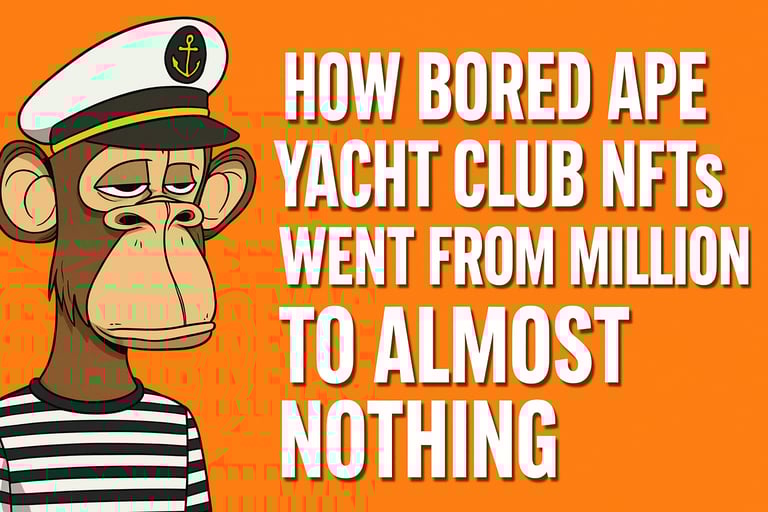
How Bored Ape Yacht Club NFTs Went from Millions to Almost Nothing
Explore the meteoric rise and rapid decline of Bored Ape Yacht Club NFTs. Learn how digital collectibles once worth millions lost their value and what lessons investors can take for the NFT market. Featuring insights with DropFinder references.
LATEST AIRDROPCRYPTO NEWS
10/23/20255 min read
How Bored Ape Yacht Club NFTs Went from Millions to Almost Nothing
In the spring of 2021, a digital art collection called the Bored Ape Yacht Club (BAYC) changed the landscape of the NFT world forever. Comprised of 10,000 unique cartoon apes, each featuring hand-drawn traits, BAYC seemed like just another NFT project. But beneath the surface was a vision far bigger than digital art—a combination of community, exclusivity, and social status. What followed was nothing short of a digital gold rush. Investors, collectors, and celebrities rushed to own these apes, and the prices skyrocketed. By late 2021, some Bored Apes were selling for millions of dollars, turning early investors into instant millionaires.
The collection offered more than a token of ownership; it offered entry into an exclusive social club. Owning a Bored Ape wasn’t simply about art—it was a ticket to online communities, private virtual events, and even physical gatherings. Buyers received full intellectual property rights to their individual apes, allowing them to create derivative merchandise, videos, and other media. The sense of ownership and control over a unique digital asset was something that no traditional art market could provide at the time.
Celebrity adoption further accelerated BAYC’s hype. Famous names like Justin Bieber, Eminem, Steph Curry, and Serena Williams showcased their Bored Apes online. Social media feeds became saturated with these digital collectibles, turning them into symbols of tech-savvy wealth and cultural relevance. With mainstream media covering the craze, the NFT market experienced unprecedented growth. From the perspective of early investors, it seemed like a once-in-a-lifetime opportunity.
The Peak: Millions on the Digital Market
The value of BAYC NFTs surged dramatically. Individual apes, minted initially for just around $200, were now trading for hundreds of thousands of dollars. The most exceptional sales reached the multi-million-dollar range. Collectors were competing to get their hands on rare traits, and the floor price—the minimum price at which an ape could be bought on secondary markets—skyrocketed.
Investor enthusiasm was fueled not just by scarcity, but by the promise of community. Owners would gain access to exclusive online forums, parties, and events. This “membership experience” created an added layer of value beyond the artwork itself. For many, BAYC ownership was as much about social status as financial speculation. Owning a Bored Ape became a badge of credibility in the world of crypto, signaling early adoption, risk-taking, and cultural relevance.
Platforms like DropFinder quickly recognized this trend, tracking NFT sales, price changes, and the flow of investment within the BAYC ecosystem. For newcomers, these tracking tools offered a window into which apes were most valuable, which traits were trending, and where potential opportunities lay. As the market heated up, investors could monitor movements in real time, ensuring they were always a step ahead—or at least trying to be.
The Turning Point: Signs of Decline
By 2022, the NFT market began to show early signs of cooling. While BAYC continued to hold cultural significance, external factors started to impact its financial appeal. Cryptocurrencies, particularly Ethereum, were highly volatile. Since NFT purchases and resales rely heavily on Ethereum, fluctuations in crypto value directly affected NFT pricing. When the broader crypto market experienced a downturn, investors felt the impact immediately, and confidence wavered.
At the same time, market saturation became an undeniable reality. The original appeal of BAYC—rarity, exclusivity, and first-mover advantage—began to dilute. Yuga Labs, the company behind BAYC, introduced the Mutant Ape Yacht Club (MAYC), expanding the universe but also fragmenting the market. While MAYC offered an entry point for newer collectors, it inadvertently reduced the exclusivity of the original Bored Apes. What had once been a unique digital treasure now faced competition from derivative collections and new NFT projects, each promising the next big return.
Economic Pressures and Investor Sentiment
Beyond crypto volatility, the broader economy played a role in BAYC’s decline. Inflation, rising interest rates, and global economic uncertainty pushed investors toward more traditional, stable investments. Many realized that NFTs, despite their potential for huge gains, were speculative and risky. A digital asset could be worth millions today and only tens of thousands tomorrow, depending on market sentiment, liquidity, and trends.
Scandals, hacks, and security breaches also eroded confidence. High-profile NFT thefts revealed that digital wallets, while secure in theory, were not immune to attacks. Stories circulated of Bored Apes stolen from collectors, with no easy path to recovery. These incidents reminded investors that digital ownership comes with technical and security responsibilities. Even the perception of risk can depress market prices, as hesitant buyers hold back.
Legal disputes surrounding BAYC further complicated the picture. Intellectual property and copyright issues arose as Yuga Labs tried to protect its brand. While some court victories reaffirmed rights for the creators, prolonged legal battles cast shadows over the collection, creating uncertainty and affecting resale confidence.
The Fall: From Millions to Minimal Value
By 2024 and 2025, BAYC’s market position had shifted dramatically. Many apes that once commanded seven-figure prices were now trading for a fraction of their peak value. For early investors who bought at the height of the craze, the losses were significant. Stories emerged of individuals who turned a few hundred thousand dollars into millions at the peak, only to see the market reverse dramatically.
The decline was not uniform, of course. Certain rare traits and historically significant apes retained more value, while the majority of the collection faced a steep drop. The phenomenon underscored the speculative nature of the market: hype can drive prices to extremes, but fundamentals, utility, and broader adoption ultimately determine long-term value.
Investors looking for lessons turned to platforms like DropFinder, which provided analytics, trend tracking, and a more measured view of NFT valuation. By analyzing past sales, tracking floor prices, and monitoring emerging projects, collectors could better understand how to approach NFTs with caution and strategy, rather than following hype alone.
Lessons from the BAYC Experience
The rise and fall of BAYC provides multiple lessons for investors, creators, and NFT enthusiasts:
Market Cycles Are Inevitable: No market grows indefinitely. Even the most popular collections are subject to fluctuations based on supply, demand, and investor sentiment.
Hype Isn’t Sustainable: Celebrity endorsements and media coverage can drive temporary value, but long-term sustainability depends on utility, community engagement, and intrinsic value.
Diversify Your Portfolio: Relying solely on NFTs or a single collection exposes investors to risk. Spread investments across different asset classes to manage potential losses.
Security Matters: Digital assets require proper storage and management. Wallet security, multi-factor authentication, and awareness of scams are essential.
Use Analytics Tools: Platforms like DropFinder can help investors make informed decisions by tracking trends, prices, and project health, rather than relying purely on speculation.
Community Is Key: NFTs with strong, engaged communities tend to retain more value over time. The social and experiential aspects of a collection can often outweigh short-term financial gains.
Cultural Impact of BAYC
Even as financial values decline, BAYC has left an indelible mark on digital culture. It was one of the first NFT projects to combine art, social status, and community membership, effectively creating a template for future collections. Virtual events, exclusive content, and online clubs became an expected feature for top-tier NFTs. In this sense, BAYC succeeded in establishing a new type of digital ownership experience.
Moreover, it forced traditional industries, including art and entertainment, to consider how blockchain technology can redefine ownership, royalties, and creative rights. Museums, brands, and celebrities are now experimenting with digital collectibles, inspired in part by the Bored Ape phenomenon.
Conclusion
The story of Bored Ape Yacht Club is one of extreme highs and stark realities. It illustrates how a speculative asset can generate immense wealth, reshape culture, and redefine ownership, yet also demonstrates the volatility and risk inherent in such investments. From the millions achieved at its peak to the steep declines that followed, BAYC is a case study in market psychology, digital innovation, and investor behavior.
For anyone entering the NFT market today, the lessons are clear: approach with research, caution, and awareness of both market trends and underlying value. Platforms like DropFinder can help navigate this dynamic landscape, offering insights and tracking tools to make informed decisions.
Ultimately, Bored Ape Yacht Club may no longer hold the extraordinary market values it once did, but its legacy in digital art, online communities, and the NFT ecosystem remains undeniable. It serves as both a cautionary tale and a source of inspiration, reminding investors that the world of digital collectibles is as thrilling as it is unpredictable.