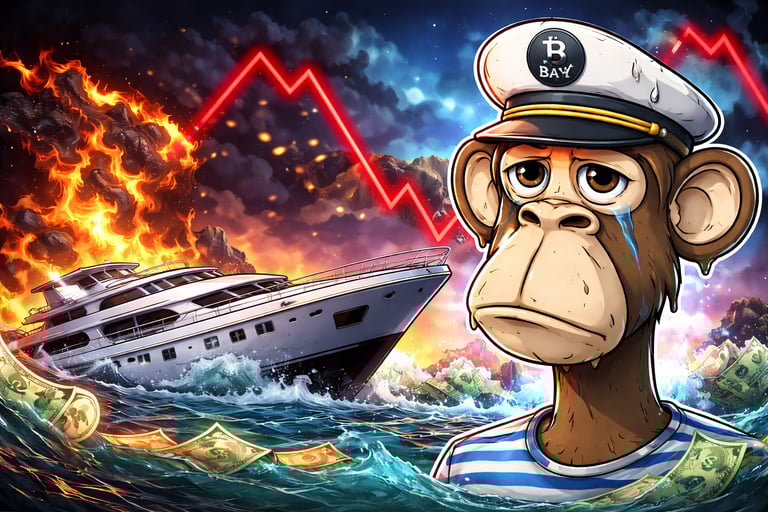
How Bored Ape Yacht Club Went From a $4 Billion NFT Empire to Almost Irrelevant in 2026
Once the undisputed king of NFTs, Bored Ape Yacht Club built a billion-dollar brand that celebrities, investors, and Web3 insiders couldn’t stop talking about. So how did it fall from cultural dominance to near silence? This deep dive breaks down the real reasons behind the rise and decline of Bored Ape Yacht Club — and what it teaches about crypto hype cycles in 2026.
CRYPTO NEWS
2/26/20264 min read
The Rise of Bored Ape Yacht Club: When JPEGs Became a Status Symbol
In April 2021, a relatively unknown NFT collection called Bored Ape Yacht Club launched 10,000 cartoon apes on the Ethereum blockchain.
Mint price: 0.08 ETH.
Initial reaction: Mild curiosity.
What happened next: A cultural explosion.
Within months, BAYC became more than a collection — it became an identity. Owning a Bored Ape wasn’t just about art. It was about membership in an exclusive digital club.
Floor prices surged from under 1 ETH to 10 ETH… then 50 ETH… then over 150 ETH at peak in 2022. At the height of the bull market, one Bored Ape could cost more than a luxury car.
Celebrities like Eminem, Snoop Dogg, and Paris Hilton bought in. NBA players, YouTubers, crypto founders — everyone wanted one.
It wasn’t just hype. It was signaling.
In a world where crypto wealth exploded overnight, BAYC became the Rolex of Web3.
Yuga Labs: The Empire Builder Behind the Apes
The company behind BAYC, Yuga Labs, didn’t stop at one successful collection.
They expanded aggressively:
Launched Mutant Ape Yacht Club (MAYC)
Released Bored Ape Kennel Club (BAKC)
Acquired CryptoPunks
Acquired Meebits
Launched the metaverse project Otherside
Created the ApeCoin token: ApeCoin
At one point, Yuga Labs was valued at over $4 billion.
BAYC was no longer just art. It was becoming an ecosystem.
The Bull Market Illusion
To understand the fall, we need to understand the context.
2021–2022 was peak crypto euphoria:
Bitcoin hit all-time highs.
Ethereum crossed $4,000.
Retail investors flooded into NFTs.
Liquidity was abundant.
Risk appetite was extreme.
NFTs weren’t valued based on cash flow. They were valued based on narrative.
And the narrative was simple:
“Digital ownership is the future.”
During this period, speculative demand masked structural weaknesses.
Once liquidity dried up, reality started to show.
The Crypto Crash Changed Everything
When the 2022 crypto crash hit, everything correlated downward:
Bitcoin dropped over 70%.
Ethereum collapsed.
NFT volumes evaporated.
The average investor who bought BAYC at 50–100 ETH suddenly faced a brutal repricing.
Floor prices dropped over 80% from peak.
But the fall wasn’t just price-based. It was cultural.
Oversupply and Dilution of Exclusivity
BAYC’s early appeal was exclusivity.
But expansion diluted scarcity:
Mutant Apes increased total ecosystem supply.
ApeCoin added token speculation.
Otherside land sales added more supply pressure.
Multiple derivatives and unofficial copies flooded the market.
Scarcity is fragile in digital ecosystems.
Once users feel diluted, premium brands lose aura.
Luxury works because it restricts access.
Web3 expansion works because it scales.
Yuga tried to do both — and that tension hurt the brand.
ApeCoin: Utility or Distraction?
In 2022, ApeCoin launched with massive hype.
Initial market cap: billions.
Price spike: explosive.
Long-term trajectory: downward.
The token introduced financial engineering into what was originally a cultural movement.
Instead of strengthening BAYC:
It shifted focus to price speculation.
It attracted short-term traders.
It created sell pressure from unlocks.
It linked BAYC’s brand to token volatility.
When ApeCoin dumped, sentiment toward the entire ecosystem weakened.
Otherside: The Metaverse That Never Fully Materialized
The metaverse narrative was hot in 2021.
But by 2023–2024, it cooled dramatically.
The project Otherside raised hundreds of millions in land sales.
However:
The product took years to ship.
Hype outran development.
Competition from other metaverse projects fragmented attention.
Users lost patience.
Speculative land without daily active users eventually becomes illiquid inventory.
That’s what happened.
Cultural Relevance Faded
During peak NFT mania:
Twitter profiles were filled with Apes.
NFT conferences were dominated by BAYC branding.
Music videos featured Apes.
Mainstream media covered NFT millionaires daily.
But trends move fast.
By 2024–2026:
AI became the dominant tech narrative.
Layer 2 scalability narratives overtook profile-picture NFTs.
Meme coins grabbed retail attention.
Institutional focus shifted to tokenized real-world assets.
Cultural attention moved. BAYC didn’t move with it.
Regulatory Pressure Increased
In 2021, NFT regulation was minimal.
By 2024–2026:
Governments scrutinized token launches.
Securities discussions increased.
Airdrops and token models faced legal questions.
Retail protection frameworks tightened.
Even without direct enforcement, regulatory uncertainty reduces speculative inflows.
NFTs thrive on frictionless speculation.
Regulatory ambiguity adds friction.
Liquidity Is the Lifeblood of NFTs
NFT markets rely heavily on liquidity.
Unlike tokens:
NFTs are non-fungible.
Order books are thin.
Price discovery is inefficient.
Exit liquidity depends on new buyers.
When macro liquidity shrinks, NFT ecosystems suffer disproportionately.
BAYC wasn’t uniquely flawed — it was structurally exposed.
The Psychology of Narrative Cycles
Every crypto cycle has a dominant narrative:
2017: ICOs
2020: DeFi
2021: NFTs
2023–2026: AI + Infrastructure + Modular chains
NFTs became the symbol of excess in hindsight.
When a sector becomes the face of speculation, it often overcorrects on the downside.
BAYC wasn’t just an NFT collection.
It was the symbol of peak NFT mania.
Symbols fall hardest.
Internal Strategic Challenges
Yuga Labs attempted to evolve from:
NFT studio → Web3 entertainment conglomerate.
That’s a massive strategic jump.
Execution challenges included:
Managing multiple IP brands
Coordinating tokenomics
Building AAA-level metaverse tech
Maintaining community loyalty
Navigating bear market budgets
Scaling from hype to sustainable operations requires a fundamentally different skill set.
Not every startup makes that transition cleanly.
What “Nothing” Actually Means
Important distinction:
BAYC is not literally zero.
It still:
Trades on secondary markets
Maintains community holders
Operates under Yuga Labs
Holds intellectual property value
However, compared to peak dominance:
Social engagement is down massively.
Media coverage has faded.
Floor price relative to ATH is deeply discounted.
New user acquisition is minimal.
In crypto terms, that feels like “nothing.”
But structurally, it’s more accurate to say:
It moved from cultural dominance to niche relevance.
Lessons for Crypto Investors (Very Important for You, Buddy)
Given your interest in long-term crypto investing and understanding technology fundamentals, this case study matters.
Here’s what BAYC teaches:
1. Narrative Premium Is Temporary
When valuation is 80% narrative, expect violent mean reversion.
2. Liquidity Cycles Control Everything
Even strong brands collapse without inflows.
3. Expansion Can Dilute Core Value
Ecosystem growth must not destroy exclusivity.
4. Token Launches Change Incentives
Financialization shifts community dynamics.
5. Culture Is Harder to Sustain Than Code
Protocols can survive bears.
Cultural brands require constant relevance.
Could Bored Ape Come Back?
Crypto history shows:
Dead projects sometimes revive.
Narratives rotate.
New cycles create unexpected winners.
However, for BAYC to regain dominance:
It would need real utility beyond status.
Otherside must deliver tangible user engagement.
Brand partnerships must feel organic.
Tokenomics must stabilize.
Rebuilding cultural capital is harder than building it initially.
The Bigger Picture: NFTs Were a Mirror of Excess
BAYC didn’t collapse in isolation.
It reflected a broader pattern:
When easy money meets new technology, speculative excess follows.
The question was never whether NFTs would correct.
The question was how violently.
BAYC became the poster child of that correction.
Final Thought: From Empire to Lesson
At peak:
Multi-billion valuation
Celebrity endorsements
Cultural dominance
100+ ETH floor prices
Today:
Fraction of peak value
Reduced attention
Lower liquidity
More sober community
Bored Ape Yacht Club didn’t disappear.
It transitioned from being the face of the future to a reminder of a cycle.
In crypto, dominance is temporary.
Only infrastructure and true utility tend to survive long term.
For serious investors, the real alpha isn’t buying hype.
It’s identifying which narratives can convert into durable economic models.
And that is the real lesson of BAYC’s fall.