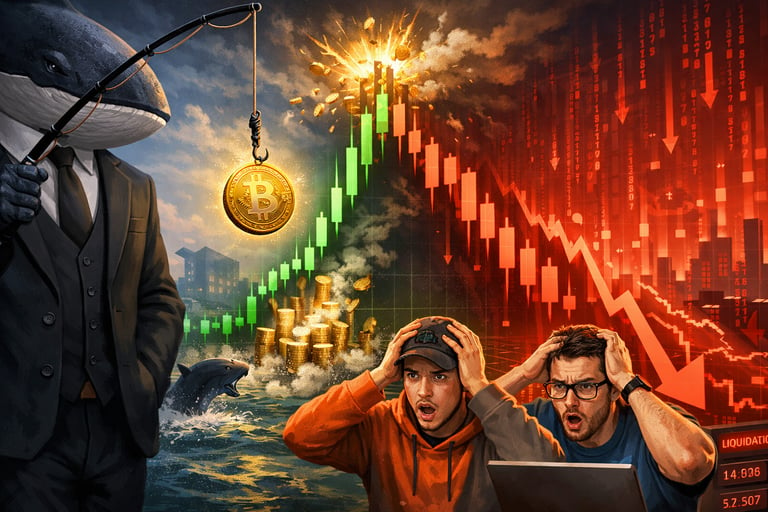
How Crypto Whales Use Fake Pumps to Liquidate Retail Traders – The Hidden Market Manipulation You’re Not Seeing
Crypto whales are using fake pumps and engineered breakouts to liquidate retail traders. Discover how liquidity hunts, stop-loss raids, and manipulation traps work — and how you can protect your capital
CRYPTO NEWS
2/21/20264 min read
You’re Not Losing by Accident
If you’ve ever entered a breakout trade and watched price instantly reverse, wiping out your position, you didn’t just get unlucky.
You likely became liquidity.
In leveraged crypto markets, large players — commonly called whales — exploit predictable retail behavior. They trigger fake breakouts, force liquidation cascades, and accumulate at better prices.
This is not conspiracy theory. It’s market microstructure.
Let’s break down how the system actually works.
What Is a Crypto Whale?
A crypto whale is an entity controlling large amounts of capital — often millions or billions of dollars in digital assets.
Major markets affected by whale activity include:
Bitcoin
Ethereum
Mid and low-cap altcoins listed on exchanges like Binance and MEXC
Because crypto markets are relatively thin compared to traditional financial markets, large capital can move price aggressively — especially in smaller coins.
Whales do not trade emotionally. They trade liquidity.
Why Retail Traders Are Easy to Predict
Retail traders typically:
Buy resistance breakouts
Short support breakdowns
Use tight stop losses
Trade with high leverage (10x–50x)
Follow social media hype
This behavior creates visible liquidity zones.
When thousands of traders place stop losses in the same area, that price level becomes a target.
Whales don’t need to guess. They see the imbalance.
The Structure of a Fake Pump
A fake pump generally follows a repeatable pattern:
1. Accumulation Phase
Price consolidates in a range with low volume. Retail interest is minimal. Smart money accumulates quietly.
2. Aggressive Push
A sudden wave of market buys pushes price above key resistance.
Retail traders interpret this as confirmation of a breakout.
They enter long positions.
Short sellers get squeezed and liquidated, adding additional upward pressure.
3. Funding and Open Interest Spike
On perpetual futures markets:
Funding rates turn highly positive
Open interest increases sharply
This signals that the majority of traders are over-leveraged long.
At this point, the market becomes fragile.
4. Distribution
Whales begin selling into the buying pressure. Price stalls near the highs.
Retail assumes a healthy pullback.
5. The Reversal
Price drops aggressively.
Long positions begin getting liquidated.
Forced market sell orders cascade through the order book, accelerating the dump.
Whales buy back at discounted prices.
Cycle complete.
How Liquidations Amplify the Move
Leverage is the main weapon against retail traders.
For example:
10x leverage means a 10% move wipes out your margin.
20x leverage means only 5% is needed.
When liquidations trigger, they execute as forced market orders. That means the exchange automatically closes your position by selling at market price.
If thousands of traders are liquidated at once, it creates a chain reaction known as a liquidation cascade.
On futures platforms such as Binance Futures and Bybit, liquidation data is publicly visible.
Whales monitor this data constantly.
They don’t chase breakouts. They hunt overexposed positioning.
Why Altcoins Are More Vulnerable
Large-cap assets like Bitcoin require significant capital to manipulate.
But many mid- and low-cap altcoins have:
Thin order books
Low liquidity
High retail participation
High leverage trading
This makes them ideal targets for engineered moves.
A relatively modest capital injection can move price 10–20% in minutes.
Retail sees momentum.
Whales see exit liquidity.
The Social Media Catalyst
Fake pumps often align with:
Influencer hype
Telegram trading groups
Rumors of partnerships
Sudden “breaking news” narratives
The psychology is simple: create urgency.
Fear of missing out causes retail traders to buy without proper confirmation.
The more emotional the market, the easier it is to extract liquidity.
Liquidity Hunts and Stop-Loss Raids
A liquidity hunt occurs when price briefly pushes into areas where large clusters of stop losses are placed.
For example:
Above a clear resistance level
Below a well-defined support level
Around equal highs or lows
Whales push price just far enough to trigger those stops.
Once triggered, those stop losses execute as market orders, fueling the move.
Immediately after liquidity is absorbed, price often reverses sharply.
This is why many traders say:
“The market always takes my stop before moving in my direction.”
It’s not personal.
It’s structural.
Real Breakout vs Engineered Breakout
Not every breakout is fake. But there are differences.
Fake Breakout Signals:
Vertical candle with no buildup
Immediate funding spike
No higher timeframe confirmation
Quick rejection wick
Genuine Breakout Signals:
Gradual volume expansion
Consolidation above resistance
Multiple timeframe alignment
Controlled funding levels
If the move feels too fast and too obvious, caution is warranted.
Funding Rates: The Hidden Warning Signal
Funding rates reflect the imbalance between longs and shorts.
When funding becomes highly positive:
Long traders are paying shorts
Market is crowded with longs
Crowded trades are vulnerable.
Whales often wait for extreme funding before initiating a reversal.
Extreme positioning creates opportunity.
The Business Model of Leverage
Crypto exchanges profit from:
Trading fees
Liquidation fees
Funding transfers
High leverage increases activity and volatility.
Volatility increases liquidations.
Liquidations increase revenue.
While exchanges do not directly manipulate price, the structural incentive favors high turnover.
Whales operate effectively within this system.
Retail traders often misunderstand it.
Why Retail Keeps Falling for the Trap
Several psychological biases are involved:
Recency bias – assuming recent momentum will continue
Confirmation bias – believing bullish signals while ignoring risks
Herd behavior – following majority sentiment
Overconfidence from small wins
Markets exploit predictable behavior.
Whales don’t need to beat you technically.
They only need to be on the opposite side of overcrowded positions.
How to Protect Yourself
If you want to avoid becoming liquidation fuel, consider:
Reduce Leverage
Lower leverage drastically reduces liquidation risk.
Wait for Retests
Instead of entering on breakout candle, wait for confirmation.
Monitor Funding
Extremely positive funding suggests overextended longs.
Trade Higher Timeframes
Lower timeframes are more easily manipulated.
Manage Position Size
Never risk your entire capital on a single move.
Survival is more important than catching every pump.
Spot vs Futures: A Strategic Shift
If you are long-term bullish on strong assets such as Bitcoin, spot accumulation eliminates liquidation risk entirely.
This is why many experienced investors avoid excessive leverage and instead accumulate during fear-driven corrections.
Whales manipulate volatility.
They don’t necessarily change long-term macro structure.
The Core Reality
Crypto markets are not purely manipulated.
But they are driven by liquidity and positioning imbalance.
Whales:
Create volatility
Exploit emotional reactions
Profit from liquidation cascades
Retail traders:
React to price
Over-leverage
Enter late
Exit in panic
The difference isn’t intelligence.
It’s discipline and capital advantage.
Final Conclusion: Stop Being Predictable
Markets reward patience, not impulse.
If you understand how liquidity hunts and fake pumps work, you stop chasing candles and start observing positioning.
The goal is not to out-muscle whales.
The goal is to avoid standing where they are hunting.
Because in leveraged crypto markets, the majority doesn’t lose by accident.
They lose by design.