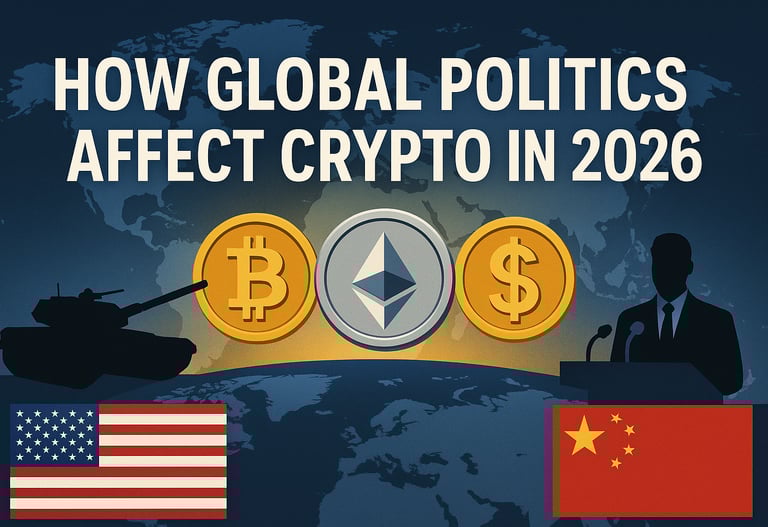
How Global Politics Affect Crypto in 2026 — A DropFinder Deep Impact Analysis
Explore how global politics will shape cryptocurrency in 2026 with this DropFinder analytical guide. Understand how regulations, international conflicts, digital currency policies, economic power shifts, and geopolitical alliances influence crypto adoption, valuation, decentralization, and long-term investor strategies.
CRYPTO NEWS
11/23/20253 min read
Introduction — Why Global Politics and Crypto Are Now Interlinked
Cryptocurrency began as a movement separate from governments, borders, and political systems. But as we move toward 2026, the global political landscape has become one of the strongest forces influencing the direction, acceptance, pricing, and regulatory environment of digital assets. What was once a decentralized rebellion has evolved into a sector deeply intertwined with international policy, finance, sanctions, national digital currency models, cyber-security priorities, capital controls, and economic sovereignty.
Crypto is no longer just a technology. It is now a strategic asset class, a geopolitical tool, and a financial instrument with national-level implications. Global politics affects how nations adopt, restrict, regulate, tax, monitor, integrate, and compete in the blockchain economy. This makes 2026 a defining year where political decisions will shape the next era of crypto evolution.
Why Politics Now Matters More Than Ever for Crypto
There are several reasons why global politics has become a dominant factor:
1. Governments Fear Loss of Monetary Control
Crypto challenges:
central banks
inflationary monetary frameworks
state-controlled financial systems
This makes crypto a political issue, not just an economic one.
2. Crypto Has Become a Tool in International Power
Nations now see blockchain:
as leverage
as a competitive technology
as a way to bypass traditional finance
3. Digital Currencies Are Becoming National Strategies
Many countries are developing:
CBDCs (Central Bank Digital Currencies)
blockchain-based settlement rails
cross-border payment networks
4. Elections Influence Crypto Policy
Leadership changes → policy changes
Policy changes → market direction shifts
5. Sanctions and Trade Wars Push Crypto Adoption
Whenever countries are restricted, decentralized finance grows.
How Different Political Forces Affect Crypto in 2026
1. Regulations and Legal Frameworks
In 2026, regulatory policies will play a defining role in:
exchange access
investor taxation
institutional adoption
banking integration
custody services
Positive regulation leads to:
✅ clarity
✅ institutional inflow
✅ mainstream acceptance
Restrictive regulation leads to:
❌ capital flight
❌ underground markets
❌ blockchain relocation
2. US Elections and Policy Direction
The United States remains the world’s largest financial influencer. Different political parties view crypto differently:
Pro-innovation stance leads to:
clearer laws
ETF expansion
enterprise blockchain integration
Anti-crypto stance leads to:
stricter tax reporting
exchange limitations
stablecoin pressure
Whichever direction emerges affects global markets because the US dollar is still central to global trade.
3. China’s Blockchain Strategy
China influences crypto through contradiction:
✅ bans public crypto
✅ supports blockchain innovation
✅ pushes digital yuan
✅ aims for global payment influence
This affects mining, liquidity flow, and Asian market behavior.
4. EU Political Alignment
Europe focuses on:
consumer protection
compliance
anti-money laundering rules
standardized frameworks
Europe prefers controlled adoption, not aggressive expansion.
5. BRICS Nations and De-Dollarization
Brazil, Russia, India, China, South Africa and expanding members are working toward:
alternative global settlements
reducing dollar reliance
blockchain-based trade systems
Crypto benefits when traditional structures weaken.
6. Wars, Conflicts, and Sanctioned Economies
When nations face sanctions or conflict:
banking becomes restricted
citizens lose access to capital
crypto becomes financial survival
Historically, this drives spikes in:
✅ stablecoin use
✅ Bitcoin adoption
✅ peer-to-peer transfers
7. Cybersecurity and National Defense Policies
Governments now classify crypto under:
digital security
cyber warfare
anti-terror finance
This increases monitoring but also increases investment in blockchain defense technologies.
How Global Political Themes Shape Crypto Market Behavior in 2026
Inflation Policies
If governments continue printing money:
✅ Bitcoin becomes an inflation hedge
✅ Store-of-value tokens strengthen
Trade Alliances
Cooperative nations may adopt shared blockchain rails.
Immigration and Capital Controls
Restricted citizens adopt crypto to move wealth.
Tax Policy
Higher tax = reduced trading
Lower tax = increased volume
Crypto Categories Most Impacted by Global Politics
1. Bitcoin
Political influence strengthens its store-of-value narrative.
2. Stablecoins
Governments see them as competition to national currencies.
3. CBDCs
State-controlled digital alternatives reshape the market.
4. Privacy Coins
Likely to face the toughest restrictions.
5. Smart Contract Platforms
Adoption depends on enterprise policies.
6. Tokenized Assets
Regulation determines how fast they scale.
Winners and Losers in a Politically-Driven Crypto Landscape
Likely Winners
✅ compliant blockchains
✅ legally recognized exchanges
✅ Bitcoin as a neutral reserve asset
✅ cross-border settlement platforms
✅ countries that embrace innovation
Likely Strugglers
❌ privacy tokens under scrutiny
❌ exchanges without licensing
❌ nations attempting full bans
❌ politically unstable economies
How DropFinder Readers Can Navigate Crypto in a Political World
DropFinder followers value:
✅ early positioning
✅ long-term thinking
✅ intelligent accumulation
✅ risk-aware decision making
Political awareness helps investors:
avoid panic decisions
understand macro signals
accumulate during regulatory uncertainty
identify geopolitical catalysts
Strategies for Crypto Investors in 2026
✅ Diversify across categories
✅ Track global election cycles
✅ Follow regulatory announcements
✅ Accumulate proven assets
✅ Avoid politically targeted coins
✅ Think in multi-year horizons
Conclusion — Politics Will Shape the Future of Crypto in 2026
Global politics now influences crypto in every dimension: legality, adoption, pricing, taxation, banking access, technological development, cross-border financial systems, and national power competition. As we move deeper into 2026, the winners in the crypto market will not only be the strongest technologies — but the projects, nations, and investors who understand that cryptocurrency is now part of the geopolitical chessboard.
Those who stay informed, patient, and strategic will benefit the most.