How Justin Bieber Lost Millions in Crypto and NFTs: A 2026 Deep-Dive Into Celebrity Investment Mistakes
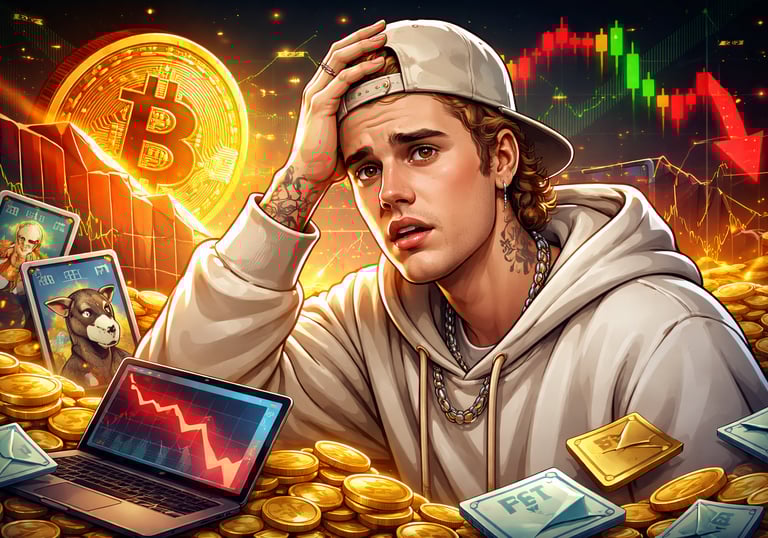
How Justin Bieber lost millions in crypto and NFTs reveals critical lessons about hype-driven investing, market psychology, and celebrity risk exposure. A detailed 2026 analysis by DropFinder.
CRYPTO NEWS
1/13/20264 min read
Introduction: When Fame Meets Financial Risk
The intersection of celebrity culture and emerging financial markets has always been volatile. In the early 2020s, cryptocurrencies and NFTs attracted global attention, not only from retail investors but also from world-famous celebrities. Among them, Justin Bieber stood out as one of the most high-profile figures to embrace digital assets publicly.
By 2026, it has become clear that Bieber’s crypto and NFT journey serves as a cautionary tale. Despite access to elite advisors, massive capital, and early entry, he reportedly lost millions of dollars across NFTs, speculative tokens, and illiquid Web3 ventures.
This blog breaks down what happened, why it happened, and what investors can learn, using Justin Bieber’s experience as a case study in hype-driven financial decisions.
The Celebrity Crypto Boom: Context Matters
Before analyzing losses, it is essential to understand the environment in which these investments occurred.
Between 2020 and 2022, crypto markets experienced an unprecedented bull run. Bitcoin crossed historic highs, Ethereum surged, and NFTs exploded into mainstream culture. Celebrities were not just passive investors; they became marketing instruments for Web3 projects.
Crypto brands actively pursued famous personalities because celebrity endorsements created instant trust and viral exposure. For artists like Justin Bieber, crypto and NFTs appeared to align perfectly with digital creativity, fan culture, and decentralization narratives.
However, most of these markets were immature, thinly regulated, and driven by speculation rather than fundamentals.
Justin Bieber’s Entry Into Crypto and NFTs
Justin Bieber did not enter crypto quietly. His involvement was visible, confident, and highly public.
He reportedly invested in:
High-profile NFTs
Metaverse-related tokens
Celebrity-endorsed Web3 platforms
Experimental blockchain startups
One of his most talked-about purchases was a Bored Ape Yacht Club NFT, acquired at the peak of the NFT bubble for a sum reportedly exceeding one million dollars.
At the time, NFTs were marketed as:
Digital status symbols
Long-term collectibles
The future of intellectual property
In reality, liquidity depended almost entirely on market sentiment, not utility.
The NFT Collapse and Value Destruction
NFTs were the first major blow to Bieber’s crypto portfolio.
As market conditions tightened in 2022 and 2023:
Trading volumes collapsed
Floor prices dropped sharply
Buyers disappeared
NFTs that were once sold for hundreds of thousands of dollars struggled to find bids even at a fraction of their original price.
By 2026, most high-profile NFT collections had:
Lost over 80–95% of peak value
Become illiquid assets
Shifted from speculative hype to niche collector markets
For celebrities like Justin Bieber, this meant paper wealth vanished, and exiting positions became nearly impossible without massive losses.
Overexposure to Hype-Driven Assets
One of the biggest mistakes was concentration risk.
Instead of diversified exposure across:
Blue-chip cryptocurrencies
Traditional investments
Revenue-generating assets
Bieber’s portfolio leaned heavily toward:
Illiquid NFTs
Early-stage tokens
Brand-driven projects
Many of these investments had no cash flow, no sustainable business model, and no long-term adoption roadmap.
When the hype cycle ended, there was nothing left to support valuations.
Celebrity Endorsements and Conflicted Incentives
Another critical issue was conflicted participation.
In several Web3 projects:
Celebrities received tokens or NFTs at preferential prices
Public promotion inflated market value
Retail investors entered at higher valuations
Once lock-ups expired or interest faded, prices crashed.
Even if unintentional, this structure created reputational and financial risk. In some cases, celebrities were left holding assets that:
Could not be sold without causing price collapse
Attracted legal scrutiny
Became socially controversial
For Justin Bieber, distancing himself from failed projects often meant accepting losses rather than continuing public association.
The Role of Advisors and Poor Due Diligence
Fame does not guarantee financial literacy.
Many celebrities rely on:
Crypto influencers
Trend-focused advisors
Friends already invested
Unlike institutional investors, celebrities often enter deals through social networks rather than rigorous analysis.
Key due diligence failures included:
Ignoring token supply mechanics
Underestimating unlock schedules
Overlooking liquidity risks
Confusing brand popularity with investment quality
By 2026 standards, many of these investments would not pass even basic risk assessment.
Market Timing: Buying the Top
Perhaps the most costly error was timing.
Justin Bieber’s most expensive crypto and NFT purchases occurred:
During peak market euphoria
When valuations were historically stretched
After early insiders had already profited
Buying at the top meant that even strong assets had limited upside and massive downside.
This is a classic behavioral finance mistake, amplified by social media visibility and peer pressure within celebrity circles.
The Psychological Cost of Public Losses
For public figures, losses are not private.
Unlike regular investors, Bieber faced:
Media scrutiny
Online criticism
Meme culture ridicule
This psychological pressure often leads to poor recovery decisions, such as:
Refusing to exit losing positions
Overcommitting to “prove belief”
Avoiding transparent acknowledgment of mistakes
By stepping back from public crypto promotion, Bieber effectively signaled that capital preservation had replaced experimentation.
Regulatory Shifts and Legal Exposure
Between 2023 and 2026, crypto regulations tightened significantly.
Authorities scrutinized:
Celebrity endorsements
Promotional disclosures
Token marketing practices
This environment increased risk for celebrities associated with failed projects, even if they were not directly responsible.
In several jurisdictions, legal frameworks evolved to treat undisclosed promotions as financial misrepresentation.
For celebrities, this added another layer of cost beyond market losses: legal risk and brand damage.
How Much Did Justin Bieber Actually Lose?
Exact figures remain private, but conservative estimates suggest:
Several million dollars lost in NFTs alone
Additional losses across altcoins and early Web3 ventures
Opportunity cost from capital locked during peak years
For someone of Bieber’s net worth, the losses were financially survivable, but symbolically significant.
They highlighted that no amount of fame protects against bad investment structure.
Lessons for Investors in 2026
Justin Bieber’s crypto experience offers timeless lessons:
1. Popularity Is Not Utility
A famous brand does not guarantee long-term value.
2. Liquidity Matters More Than Hype
If you cannot exit, you do not own an asset—you own a risk.
3. Diversification Is Non-Negotiable
Overexposure to experimental assets magnifies downside.
4. Advisors Must Be Incentive-Aligned
Trend-chasing advisors often disappear after losses.
5. Timing Is a Strategy
Buying late in a cycle is speculation, not investment.
The Shift Toward Smarter Capital Allocation
By 2026, many celebrities—including Justin Bieber—have:
Reduced public crypto involvement
Shifted toward private equity and established brands
Focused on controllable ventures like music catalogs and touring
This reflects a broader maturation of celebrity finance, moving away from speculative hype toward risk-adjusted returns.
Final Thoughts: A Necessary Reality Check
Justin Bieber did not lose millions because crypto is inherently flawed. He lost money because markets punish excess, speed, and blind optimism—regardless of fame.
His experience mirrors that of millions of retail investors worldwide, making it one of the most relatable celebrity crypto stories of the decade.
In 2026, the lesson is clear:
Wealth preservation requires discipline, not trends.