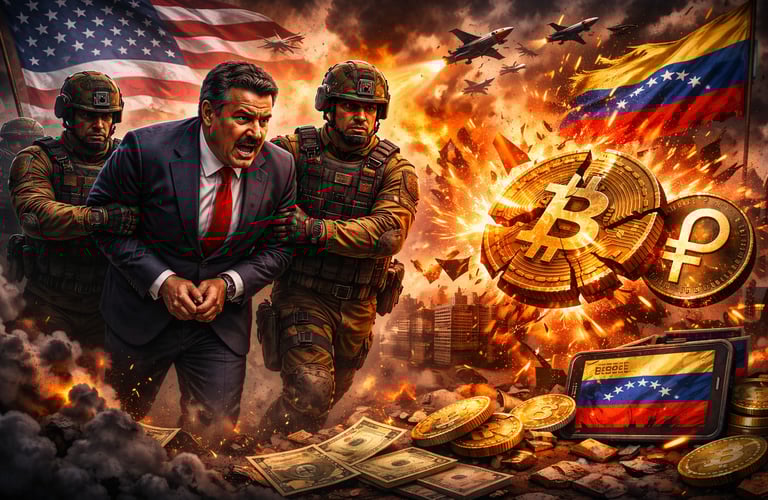
How the U.S. Capture of Venezuela’s President Could Trigger a Crypto Bloodbath in January 2026
The reported U.S. capture of Venezuela’s president in January 2026 could unleash extreme volatility across Bitcoin and altcoins. This deep analysis explains how geopolitics, oil, sanctions, capital flight, and market psychology may collide to shake the crypto market worldwide.
CRYPTO NEWS
1/3/20264 min read
Introduction: A Shock That Crypto Was Not Prepared For
January 2026 may be remembered as one of the most destabilizing moments for global crypto markets—not because of a protocol failure or exchange collapse, but due to geopolitics returning violently to center stage.
Reports claiming that the United States has captured the Venezuelan president represent a geopolitical earthquake. Unlike routine sanctions or diplomatic pressure, a direct leadership capture signals regime change, military escalation, and a breakdown of global norms. Financial markets do not react calmly to such events, and crypto markets—often misunderstood as “detached” from global politics—are particularly vulnerable in the short term.
Crypto thrives on narratives: decentralization, neutrality, censorship resistance. But when real-world power dynamics clash head-on with capital flows, liquidity, and risk appetite, crypto becomes a pressure valve rather than a safe haven.
This article explains, in depth, how the U.S. capture of Venezuela’s president could reshape crypto markets in January 2026—and why traders, long-term holders, and builders should be extremely cautious.
Venezuela’s Role in the Global Crypto Ecosystem
Venezuela is not a peripheral country when it comes to crypto adoption. For nearly a decade, it has served as a live experiment in what happens when fiat systems collapse.
Hyperinflation destroyed trust in the bolívar. Capital controls restricted access to dollars. Sanctions isolated the banking system. Crypto became a survival tool, not a speculative asset.
Millions of Venezuelans use Bitcoin, stablecoins, and peer-to-peer networks to:
Preserve value
Receive remittances
Conduct international trade
Escape financial surveillance
When a state with high grassroots crypto dependency experiences sudden regime shock, the effects ripple far beyond its borders.
Why This Event Is Different From Past Sanctions
Markets have learned to “price in” sanctions. They have not priced in open leadership capture by a superpower.
This distinction matters.
Sanctions are gradual. They create slow capital flight.
Leadership capture is abrupt. It creates panic.
The immediate result is uncertainty over:
Who controls national reserves
Whether oil exports continue
How allies and adversaries respond
Whether retaliation occurs elsewhere
Crypto markets react poorly to uncertainty spikes, especially when they originate outside the financial system.
The Immediate Market Reaction: Risk-Off Dominates
When geopolitical shocks hit, markets move into “risk-off” mode. Capital seeks safety, liquidity tightens, and volatility spikes.
In January 2026, crypto is likely to experience:
Sudden Bitcoin sell-offs
Sharp altcoin underperformance
Stablecoin dominance surge
Increased exchange inflows (panic selling)
Despite Bitcoin’s “digital gold” narrative, short-term traders still treat it as a high-beta asset. In moments of fear, they sell first and ask questions later.
This is not ideological. It is mechanical.
Leverage unwinds quickly. Funding rates flip. Liquidations cascade.
Oil, Energy Markets, and the Indirect Crypto Impact
Venezuela remains a major oil producer. Any disruption in leadership threatens supply stability.
Rising oil prices impact crypto indirectly through:
Higher inflation expectations
Tighter monetary policy assumptions
Reduced risk appetite in speculative assets
If energy prices spike, central banks become less flexible. Rate cut expectations vanish. Liquidity stays tight.
Crypto, especially altcoins, depends heavily on excess liquidity. Without it, narratives die quickly.
Stablecoins Under Pressure: The Quiet Epicenter
Stablecoins will likely be at the center of this storm.
A surge in:
USDT
USDC
On-chain dollar demand
sounds bullish at first—but it is not.
Rising stablecoin dominance often signals fear, not confidence. It means traders are exiting positions, not deploying capital.
Additionally, regulators may scrutinize stablecoin flows more aggressively if they suspect geopolitical sanction evasion. That increases compliance risk and operational friction across exchanges.
Any hint of stablecoin freezing or blacklisting could send shockwaves through DeFi and centralized platforms alike.
Bitcoin’s Identity Crisis Returns
Every major crisis forces Bitcoin into an identity test.
Is it:
A safe haven?
A risk asset?
A political hedge?
A speculative tool?
In January 2026, Bitcoin may fail all four simultaneously in the short term.
Why?
Because during sudden shocks, liquidity matters more than ideology.
Institutions will reduce exposure. Retail will panic. Narratives will collapse temporarily.
This does not mean Bitcoin is broken. It means Bitcoin is still embedded in global capital systems—whether crypto maximalists like it or not.
Altcoins Face a Survival Test
If Bitcoin struggles, altcoins bleed.
History shows that during geopolitical shocks:
Layer 2 tokens drop harder
New narratives lose momentum
Low-liquidity projects collapse
Meme coins implode
January 2026 could wipe out months of altcoin gains in weeks.
Projects with no real revenue, weak treasuries, or overinflated valuations will not survive prolonged uncertainty.
Builders should focus on runway, not hype. Traders should focus on capital preservation, not hero trades.
Capital Flight and On-Chain Surveillance
One paradox of geopolitical chaos is increased blockchain usage paired with increased surveillance.
As Venezuelan citizens and elites attempt capital escape:
On-chain volume increases
Stablecoin transfers surge
OTC desks activate
Simultaneously:
Governments monitor flows
Wallets get flagged
Compliance pressure rises
This dual effect increases blockchain activity but suppresses speculative upside.
High usage does not automatically mean higher prices.
The Psychological Impact: Fear Is Contagious
Markets are psychological systems.
When headlines involve:
Military action
Captured leaders
Regime change
Fear spreads beyond rational analysis.
Retail investors overreact. Influencers amplify panic. Algorithms trade momentum.
Crypto’s 24/7 nature magnifies this effect. There is no closing bell to cool emotions.
A single weekend headline can erase billions in market capitalization before Asia even wakes up.
Could This Ever Turn Bullish for Crypto?
Yes—but not immediately.
Longer term, events like this reinforce why censorship-resistant money exists. They validate Bitcoin’s original thesis.
But validation does not equal short-term price appreciation.
Historically, crypto becomes bullish after stability returns, not during chaos.
January 2026 is more likely to be a shakeout than a breakout.
What Smart Investors Should Do Now
This is not a time for leverage.
It is a time for:
Reducing exposure
Holding dry powder
Monitoring stablecoin flows
Watching oil and dollar strength
Avoiding emotional trades
Volatility creates opportunity—but only for those who survive it.
Final Thoughts: Why January 2026 Matters
The U.S. capture of Venezuela’s president is not just a political event. It is a stress test for global systems—financial, ideological, and technological.
Crypto will not escape unscathed.
January 2026 may remind investors of an uncomfortable truth:
Crypto is global, but it is not immune.
Those who understand geopolitics, liquidity cycles, and human psychology will navigate this period better than those chasing narratives.
DropFinder will continue tracking how real-world power struggles reshape crypto markets—because ignoring geopolitics is no longer an option in this industry.