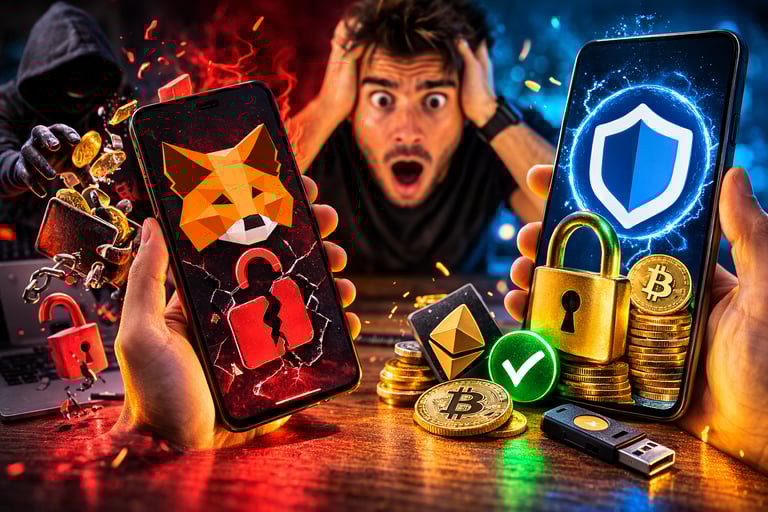
MetaMask vs Trust Wallet in 2026: One Hidden Difference That Could Decide Whether Your Crypto Is Safe or Gone Forever
MetaMask vs Trust Wallet — which wallet is actually safer in 2026? Millions of users trust these wallets, but one hidden difference could decide whether your crypto stays safe or disappears. Read this before choosing your wallet.
CRYPTO NEWS
3/14/20265 min read
The Wallet Choice That Could Decide the Fate of Your Crypto
Choosing between MetaMask and Trust Wallet in 2026 is not a small decision.
Every year, thousands of crypto users lose their funds because they trusted the wrong wallet setup, clicked the wrong approval, or misunderstood how their wallet actually protects their assets.
The shocking part?
Most of these losses don’t happen because of hackers breaking wallets. They happen because users unknowingly approve malicious smart contracts or interact with fake websites.
That is why the wallet you choose matters more than you think.
Two wallets dominate the crypto world today: MetaMask and Trust Wallet.
Both claim to be secure.
Both are used by millions of investors.
Both support thousands of tokens and decentralized apps.
But behind the scenes, there are critical differences in security design, ecosystem integration, and attack risks.
And understanding those differences could literally save your crypto portfolio.
In this deep guide, we will uncover:
Which wallet is actually safer in 2026
The hidden risks most users never notice
Why many experienced traders prefer one over the other
The biggest mistakes that lead to stolen crypto
And which wallet is better for beginners and long-term holders
Let’s break it down.
What Is MetaMask?
MetaMask is one of the most widely used non-custodial cryptocurrency wallets in the world.
It was originally created as a browser extension wallet designed to connect users directly with decentralized applications (dApps).
Over time, it expanded to mobile platforms and became the default wallet for Web3 users.
MetaMask primarily supports Ethereum and Ethereum-compatible blockchains, including:
Ethereum
Arbitrum
Polygon
Optimism
BNB Chain
Avalanche
Base
This makes MetaMask extremely powerful for users interacting with DeFi platforms, NFT marketplaces, and Web3 applications.
Because of its deep integration with decentralized apps, MetaMask has become the standard gateway to the Web3 ecosystem.
However, that same openness also introduces some security considerations.
What Is Trust Wallet?
Trust Wallet is another extremely popular non-custodial crypto wallet, but it focuses more on being a multi-chain mobile wallet.
It was launched in 2017 and later acquired by Binance, which helped accelerate its global adoption.
Unlike MetaMask, Trust Wallet was designed from the beginning to support many blockchains inside one wallet.
These include:
Bitcoin
Ethereum
BNB Chain
Solana
Polygon
Tron
Avalanche
Cosmos ecosystem tokens
Trust Wallet supports millions of assets across dozens of networks, making it a powerful all-in-one wallet for mobile users.
Instead of focusing mainly on Web3 browser interaction, Trust Wallet prioritizes simple storage, easy swaps, and multi-chain compatibility.
This difference in philosophy is important when comparing security.
Security Fundamentals: How Both Wallets Protect Your Crypto
Both MetaMask and Trust Wallet are non-custodial wallets.
This means:
You control your private keys
No company holds your funds
Only your seed phrase can recover your wallet
When you create either wallet, you receive a 12-word recovery phrase.
This phrase is the master key to your crypto.
Anyone who gets access to this phrase can instantly take control of your wallet and transfer all funds.
Neither MetaMask nor Trust Wallet can recover lost funds if your seed phrase is stolen.
This makes personal security practices extremely important.
The Biggest Security Threat Most Users Ignore
Most people believe hackers “break into” crypto wallets.
But in reality, the biggest threat is wallet approvals.
When using DeFi or NFT platforms, you often approve smart contracts that can interact with your wallet.
If that smart contract is malicious, it can potentially drain your tokens.
This risk exists in both MetaMask and Trust Wallet.
However, the frequency of this risk differs because of how each wallet is used.
MetaMask users interact with far more decentralized applications, which increases exposure to malicious contracts.
Trust Wallet users generally interact with fewer dApps, especially beginners who mainly store crypto.
So while MetaMask itself is not insecure, its usage environment carries more risk.
MetaMask Security Strengths
MetaMask offers several powerful security features.
One of its biggest advantages is dApp transparency.
When connecting to decentralized platforms, MetaMask clearly displays:
Contract approval requests
Token permissions
Gas fees
Transaction details
This allows experienced users to review exactly what they are approving.
MetaMask also integrates easily with hardware wallets, including Ledger and Trezor.
Using a hardware wallet with MetaMask dramatically increases security because private keys never leave the hardware device.
For advanced users, this combination is considered one of the safest setups in crypto.
MetaMask also receives regular security updates due to its large developer community.
Trust Wallet Security Strengths
Trust Wallet focuses on simplicity and mobile security.
One of its key advantages is built-in biometric protection, including fingerprint and face unlock.
This adds an additional layer of protection on mobile devices.
Trust Wallet also features:
Encrypted private keys stored locally
Open-source wallet core components
Built-in phishing detection
A secure mobile environment
Because it is primarily a mobile wallet, many users find it harder to accidentally interact with malicious websites compared to browser wallets.
For beginners who mainly hold crypto rather than actively trade DeFi, Trust Wallet offers a simpler and safer experience.
Why Many Crypto Hacks Involve MetaMask
If you search crypto forums, you will notice that many wallet drain stories mention MetaMask.
But this does not mean MetaMask itself is unsafe.
The real reason is simple.
MetaMask has over 30 million users and dominates the DeFi ecosystem.
Most phishing websites are designed specifically to target MetaMask users.
These scams often involve:
Fake NFT mint sites
Fake airdrops
Fake DeFi platforms
Fake wallet connection prompts
When users connect MetaMask and approve malicious transactions, funds can be drained.
This risk exists mainly because MetaMask is deeply integrated into Web3.
Trust Wallet users encounter fewer of these attacks because the wallet is used more for holding assets rather than interacting with experimental DeFi apps.
User Experience and Ease of Use
Trust Wallet is widely considered more beginner-friendly.
The interface is simple and designed primarily for mobile users.
Adding tokens, sending crypto, and swapping assets are all extremely straightforward.
MetaMask, on the other hand, can feel confusing for new users.
Managing networks, adding RPC endpoints, adjusting gas fees, and interacting with smart contracts requires more understanding.
But this complexity is also what makes MetaMask extremely powerful.
For users deeply involved in DeFi, NFTs, and Web3 apps, MetaMask provides far more flexibility.
Multi-Chain Support Comparison
Trust Wallet clearly wins in multi-chain support.
It supports dozens of blockchains natively, including Bitcoin and Solana.
MetaMask focuses primarily on Ethereum-compatible networks.
Although custom networks can be added, MetaMask still cannot directly support some major ecosystems without bridges or external tools.
For users holding a wide range of assets across different blockchains, Trust Wallet offers a more convenient experience.
Which Wallet Is Better for Beginners?
For beginners entering crypto in 2026, Trust Wallet is usually the easier choice.
It offers:
Simpler interface
Built-in staking options
Multi-chain asset support
Mobile-friendly design
Lower interaction risk with malicious dApps
New users who mainly buy and hold crypto will likely feel more comfortable with Trust Wallet.
Which Wallet Is Better for Advanced Users?
Advanced crypto users often prefer MetaMask.
This is because MetaMask is deeply connected to the entire Web3 ecosystem.
It works seamlessly with:
DeFi platforms
NFT marketplaces
DAO governance systems
Layer-2 networks
Web3 gaming platforms
For users actively exploring decentralized applications, MetaMask is almost unavoidable.
But it also requires greater caution and awareness.
The Real Secret to Wallet Security
The truth is that wallet safety depends less on the wallet itself and more on how the user manages their security.
The most common causes of crypto theft include:
Sharing seed phrases
Connecting wallets to fake websites
Approving malicious smart contracts
Installing fake wallet apps
Falling for phishing links
No wallet can protect against these mistakes.
The safest approach is always to combine your wallet with a hardware wallet and strong security practices.
Final Verdict: MetaMask vs Trust Wallet in 2026
Both wallets are secure when used properly.
But they serve slightly different types of users.
Trust Wallet is better for:
Beginners
Mobile users
Multi-chain investors
Long-term holders
MetaMask is better for:
DeFi users
NFT traders
Web3 developers
Advanced crypto participants
In terms of raw security, neither wallet is inherently unsafe.
However, MetaMask users face greater exposure to phishing and malicious contracts because of deeper Web3 interaction.
For simple crypto storage, Trust Wallet often feels safer.
For full Web3 access, MetaMask remains the most powerful option.
The Most Important Rule Before Using Any Wallet
Before storing large amounts of crypto in any wallet, always remember this:
Your seed phrase is your real wallet.
Never store it online.
Never screenshot it.
Never share it with anyone.
Because in crypto, once funds are gone — there is no customer support that can bring them back.
And that is the rule every crypto user eventually learns.
Often the hard way.