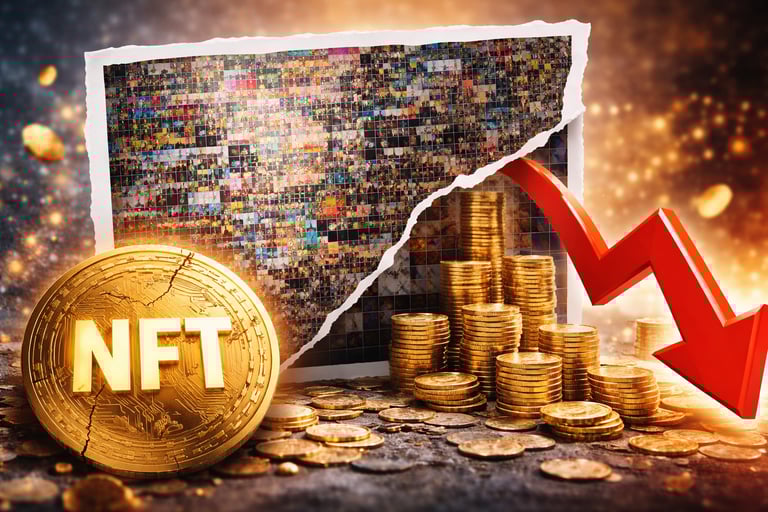
The $69 Million NFT That Became Almost Worthless How the Most Expensive Digital Artwork Crashed Over 99%
It sold for $69 million and was hailed as the future of digital art and blockchain ownership. Just a few years later $69 Million NFT That Became Almost Worthless . What went wrong? Here’s the shocking story behind the most expensive NFT ever sold — and the brutal lesson it left behind.
CRYPTO NEWS
2/20/20264 min read
The NFT That Changed the Internet
In March 2021, digital artist Beeple shocked the world when his artwork “Everydays: The First 5000 Days” sold for $69.3 million at Christie's.
It wasn’t a painting.
It wasn’t a sculpture.
It was a JPEG file — tokenized as an NFT on the blockchain.
This sale instantly became:
The most expensive NFT ever sold at that time
One of the top three most expensive works by a living artist
A historic moment for cryptocurrency adoption
Mainstream media declared NFTs the future. Crypto investors celebrated. Social media went into frenzy mode.
But markets don’t run on excitement forever.
Why Did It Sell for $69 Million?
To understand the collapse, we must analyze the conditions that created the explosion.
1. Peak Crypto Bull Market
In early 2021:
Bitcoin was approaching all-time highs
Ethereum was surging dramatically
Retail investors had stimulus liquidity
Speculation was everywhere
Money was easy. Risk appetite was extreme. When liquidity floods markets, speculative assets rise fastest.
NFTs became the hottest narrative in crypto.
2. The Power of Institutional Validation
The NFT wasn’t sold on a random crypto website. It was auctioned by Christie's, one of the most respected auction houses in the world.
This created a psychological shift.
If the same auction house that sold Picasso and Warhol is selling NFTs, then NFTs must be legitimate — that was the public perception.
Institutional validation reduces skepticism. And reduced skepticism increases bidding intensity.
3. The Narrative of Digital Ownership
NFTs promised something revolutionary:
True digital scarcity
Blockchain-based authenticity
Creator royalties
Ownership independent of centralized platforms
For the first time, digital art could be verifiably owned.
That idea alone fueled enormous speculative enthusiasm.
The Buyer and the Bubble Dynamic
The NFT was purchased by crypto investor Vignesh Sundaresan (MetaKovan), who paid in Ethereum.
This detail matters.
The transaction occurred during a period when crypto wealth felt unlimited. Many investors believed blockchain assets would appreciate indefinitely.
This was a classic bubble characteristic:
Crypto gains were recycled into even riskier crypto assets.
When asset appreciation fuels further speculation, markets become self-reinforcing — until liquidity dries up.
The Collapse: What Changed?
By 2022, everything shifted.
Global interest rates began rising. Inflation surged. Risk appetite evaporated. Crypto entered a brutal bear market.
Ethereum’s price dropped sharply. NFT trading volumes collapsed by over 90% across major marketplaces. Floor prices of once-hyped collections fell dramatically.
The speculative premium vanished.
And with it, demand for ultra-expensive digital art disappeared.
Why Did Its Value Fall Over 99%?
Technically, the NFT hasn’t been publicly resold at a confirmed 99% discount. However, market bids, liquidity, and comparable valuations suggest that its effective resale value is a fraction of the original price.
Here’s why.
1. Extreme Illiquidity
An asset priced at $69 million requires:
Ultra-high-net-worth buyers
Strong NFT market confidence
Positive crypto momentum
Cultural relevance
Remove those factors, and buyers vanish.
Ultra-expensive NFTs are among the most illiquid assets in the world.
2. No Cash Flow or Yield
Stocks produce earnings.
Real estate generates rental income.
Bonds pay interest.
Most NFTs generate no income.
Their value depends entirely on demand and narrative strength.
When hype fades, there is no fundamental floor to stop the fall.
3. Peak Euphoria Pricing
The $69.3 million price likely represented the top of the NFT hype cycle.
History shows that assets sold at peak mania often mark cycle highs:
Dot-com stocks in 2000
Housing in 2008
ICO tokens in 2017
Peak transactions are rarely rational.
They reflect emotion, not fundamentals.
4. Narrative Reversal
In 2021, NFTs symbolized innovation.
By 2023, they became synonymous with excess speculation.
Narratives drive valuations more than intrinsic value in emerging markets.
When perception changes, price collapses quickly.
Behavioral Finance at Play
The NFT bubble was a case study in investor psychology.
Fear of Missing Out (FOMO)
Investors watched early NFT flippers earn massive profits. Social media amplified success stories. This triggered irrational entry at higher and higher prices.
Greater Fool Theory
Many participants believed they could sell to someone else at an even higher price later.
This works only as long as new buyers enter the system.
When buyer growth slows, the chain breaks.
Social Proof
Institutional involvement and celebrity endorsements created perceived legitimacy. That perception inflated risk tolerance.
But institutions and celebrities can also be caught in bubbles.
Are NFTs Completely Dead?
No.
The speculative mania phase has ended, but blockchain-based digital ownership still has applications:
Gaming assets
Digital identity
Tokenized real-world assets
Intellectual property rights
However, the era of impulsive multi-million-dollar art flips appears over — at least for now.
Could It Ever Recover?
Possible, but unlikely in the near term.
For recovery, the following would need to happen:
A new major crypto bull run
Renewed NFT cultural relevance
Institutional art market re-entry
Strong liquidity conditions
Markets are cyclical. But assets that peak during mania often struggle to reclaim previous highs.
Some never do.
Historical Parallels
Dot-Com Bubble
In 2000, internet companies with no revenue achieved billion-dollar valuations. Most collapsed. A few survived and built real value.
The crash removed excess while preserving innovation.
Tulip Mania
In 1637, tulip bulbs reached absurd prices in the Netherlands before collapsing.
Speculative assets often disconnect from intrinsic value during euphoric phases.
NFTs followed a similar psychological pattern.
The Bigger Lesson
The $69 million NFT was not just art.
It was a liquidity event.
A symbol of extreme optimism.
A reflection of an environment where:
Money was abundant
Risk was celebrated
Skepticism was low
When the macroeconomic tide shifted, speculative pricing collapsed.
Markets always revert toward rationality after emotional extremes.
Why This Matters Today
Because bubbles never truly disappear.
They rotate.
Today we see speculative excess forming in other areas:
Artificial intelligence stocks
Meme cryptocurrencies
Niche asset classes fueled by social media
Understanding how the most expensive NFT effectively lost over 99% of its valuation helps investors recognize warning signs early:
Parabolic price action
Media overexposure
Celebrity endorsements
Weak underlying fundamentals
Speculation without intrinsic support is fragile.
Final Conclusion
The NFT that sold for $69.3 million at Christie's by Beeple will always remain historically significant.
But its market trajectory illustrates a harsh reality:
Hype can create astronomical prices.
Liquidity can inflate valuations beyond logic.
And when sentiment reverses, collapses can be catastrophic.
A 99% drawdown is not impossible in speculative markets. It is common.
This story is not about digital art failing.
It is about human psychology repeating.
Markets amplify emotion.
And emotion, when unchecked, destroys capital.