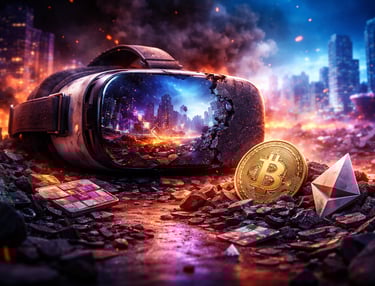
The Metaverse Collapse: Why Crypto’s Biggest Dream Failed So Fast in 2026
The metaverse was supposed to create trillion-dollar opportunities in crypto and virtual land. Instead, most projects collapsed. Discover the shocking reasons why the metaverse hype died and what crypto investors learned from it.
CRYPTO NEWS
3/12/20265 min read
The Metaverse Was Supposed to Be the Future of Crypto
Just a few years ago, the metaverse was the hottest trend in both technology and cryptocurrency. Investors believed it would replace the traditional internet and create a massive digital economy where people could work, socialize, and trade virtual assets.
Crypto projects promised something revolutionary:
Digital land worth millions
Play-to-earn gaming economies
Virtual businesses and concerts
Entire cities inside digital worlds
Huge companies and venture capital firms invested billions into this idea. At the peak of the hype, many analysts predicted the metaverse economy could reach $5 trillion within the next decade.
Crypto investors rushed to buy metaverse tokens and virtual land, believing they were early to the next internet revolution.
But just a few years later, the excitement collapsed. Many metaverse platforms lost users, token prices crashed, and even big tech companies started quietly reducing their investments.
So what exactly went wrong?
The Massive Hype That Created Unrealistic Expectations
One of the biggest reasons for the metaverse collapse was extreme hype.
Tech influencers, venture capitalists, and crypto promoters described the metaverse as if it would replace the internet within a few years. The idea sounded exciting: instead of browsing websites, people would enter immersive 3D worlds.
But the reality was very different.
Most metaverse platforms were still extremely early in development. Graphics were basic, interactions were limited, and the technology required powerful hardware that most people didn’t own.
Yet investors poured billions into these projects before they were actually ready for mainstream users.
This created a dangerous situation where expectations were far ahead of reality.
Crypto Speculation Destroyed the Core Idea
The metaverse originally focused on creating immersive digital experiences. But once cryptocurrency became involved, speculation quickly took over.
Instead of building engaging virtual worlds, many projects focused on selling virtual land NFTs and tokens.
People weren’t buying digital land because they wanted to use it. They were buying it because they expected prices to rise.
Some virtual land plots sold for hundreds of thousands of dollars during the hype cycle.
But when speculation slowed down, the demand disappeared.
Without new buyers entering the market, prices crashed dramatically.
This exposed a major problem: many metaverse economies were driven by speculation rather than real usage.
Virtual Land Became a Massive Bubble
During the metaverse boom, owning digital land became one of the biggest trends in crypto.
Platforms claimed that virtual land would become as valuable as real estate in major cities. Influencers promoted the idea that early investors could build virtual businesses and earn passive income.
However, most people never actually used their land.
Large areas of many metaverse worlds remained empty, with very few active users visiting them.
This created a situation where virtual land prices were completely disconnected from real demand.
When investors realized that most land had no real utility, the bubble quickly burst.
The Technology Was Not Ready
Another major problem was that the technology required for a true metaverse simply wasn’t ready yet.
The vision of the metaverse included:
Fully immersive VR environments
Realistic digital avatars
Massive multiplayer worlds
Seamless interaction between different platforms
But current technology still struggles with these goals.
Virtual reality headsets remain expensive and uncomfortable for long periods. Internet infrastructure in many regions cannot support massive real-time 3D environments.
Even powerful gaming computers sometimes struggle to run large virtual worlds smoothly.
Because of these limitations, most metaverse platforms felt more like basic video games rather than the future of the internet.
Lack of Real Users
Perhaps the most damaging issue for the metaverse was the lack of active users.
During the hype phase, platforms claimed millions of users and massive engagement.
But later data revealed that many of these worlds had very small daily active user numbers.
Some metaverse platforms that were valued in the billions had only a few thousand active users.
This created a huge disconnect between valuation and actual usage.
Without a large community of users, the virtual economies could not survive.
Big Tech Misjudged Consumer Behavior
Major technology companies also played a big role in the metaverse hype.
Some companies even rebranded their entire identity around the concept. They believed that people would quickly adopt virtual worlds for work, entertainment, and social interaction.
But consumer behavior did not match these expectations.
Most people prefer quick and simple online experiences.
Scrolling social media or watching videos on a phone is much easier than putting on a VR headset and entering a complex virtual world.
Because of this, many users simply ignored metaverse platforms.
Play-to-Earn Gaming Failed
One of the biggest promises of the crypto metaverse was play-to-earn gaming.
The idea was simple: players could earn cryptocurrency rewards while playing games.
Initially, this attracted huge interest. Thousands of players joined early metaverse games hoping to earn income.
But most play-to-earn economies were unsustainable.
Rewards depended on new players joining and buying tokens. When growth slowed, the entire system started collapsing.
Token prices fell, rewards decreased, and players quickly lost interest.
Instead of fun games, many platforms felt like financial systems disguised as games.
Poor Game Quality
Another reason for the metaverse failure was the low quality of many games and experiences.
Compared to traditional gaming giants, most metaverse games looked outdated.
Modern games developed by large studios offer:
Advanced graphics
Deep storylines
Highly polished gameplay
Many metaverse games, however, were rushed to market to take advantage of crypto hype.
As a result, they lacked the quality required to keep players engaged.
Without compelling entertainment, users had little reason to stay.
Crypto Market Crashes Accelerated the Decline
The broader cryptocurrency market also played a role in the decline of the metaverse.
When crypto prices dropped sharply during market downturns, metaverse tokens were hit even harder.
Many projects lost more than 90% of their value from peak prices.
Once token prices collapsed, investor interest quickly disappeared.
Funding dried up, development slowed, and many projects quietly shut down.
Investors Realized the Business Model Was Weak
As the hype faded, investors began asking a simple question:
Where is the real revenue coming from?
Many metaverse projects relied heavily on token sales and NFT sales for funding.
But once those sales slowed, the business models looked fragile.
A sustainable platform needs consistent revenue from services, subscriptions, or products.
Many metaverse platforms never developed these long-term revenue streams.
The Metaverse May Have Arrived Too Early
Despite its struggles, the concept of the metaverse may not be completely dead.
Many analysts believe the idea simply arrived too early.
Technological revolutions often take decades to mature. The internet itself took many years before reaching mainstream adoption.
Advances in several areas could eventually revive the metaverse concept:
Better VR and AR hardware
Faster internet infrastructure
Improved gaming engines
More natural digital interaction
When these technologies become more advanced, the idea of persistent digital worlds could return in a stronger form.
Lessons Crypto Investors Learned
The rise and fall of the metaverse taught several important lessons for crypto investors.
First, hype alone cannot sustain a project. Real user demand is essential.
Second, speculation without utility eventually collapses.
Third, technology adoption takes time, and revolutionary ideas rarely happen overnight.
Investors who chased the metaverse hype learned that even exciting narratives must be supported by real products and real communities.
What Comes After the Metaverse?
While the metaverse hype has cooled, innovation in crypto continues.
New trends such as AI integration, decentralized infrastructure, and real-world asset tokenization are now attracting attention.
These sectors focus more on solving real problems rather than building speculative virtual economies.
The next major crypto revolution may come from technologies that offer practical value instead of purely digital speculation.
Final Thoughts
The metaverse once promised to become the next generation of the internet.
For a brief moment, it captured the imagination of investors, developers, and tech giants around the world.
But unrealistic expectations, technological limitations, and speculative economics caused the dream to collapse faster than many expected.
The metaverse did not completely fail as an idea. Instead, it revealed how difficult it is to build an entirely new digital universe.
One day the metaverse may return in a more advanced form. But for now, the hype cycle has ended — leaving behind an important lesson about the dangers of chasing the next big thing too quickly.