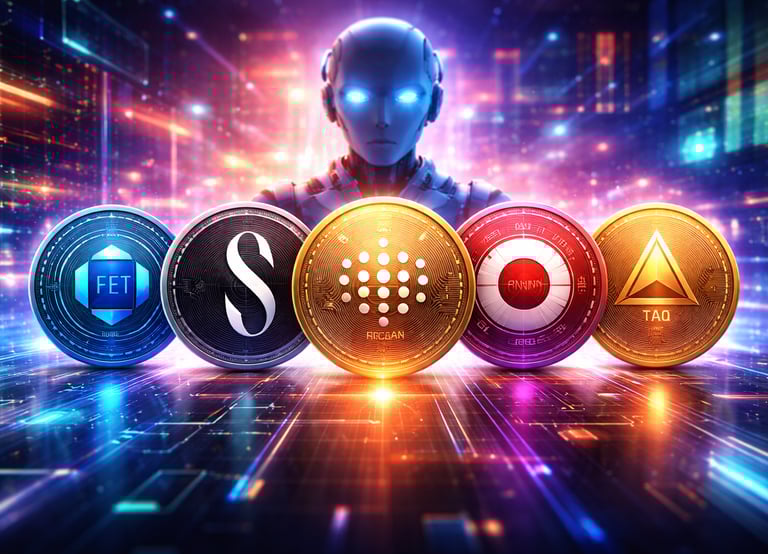
These 5 AI Coins Could Explode 100x in 2026 – Smart Money Is Loading Before It’s Too Late
The AI crypto wave is accelerating fast. Institutions are entering, developers are building, and early investors are positioning quietly. These 5 AI coins have real utility, strong tokenomics, and explosive upside potential.
CRYPTO NEWS
2/22/20263 min read
These 5 AI Coins Could Explode 100x in 2026
Artificial Intelligence is no longer speculative hype. It is now embedded across finance, automation, robotics, enterprise analytics, and consumer platforms. Global corporations are integrating machine learning at scale, and governments are prioritizing AI infrastructure.
At the same time, blockchain technology is evolving beyond payments and DeFi. It is building decentralized compute networks, data markets, and autonomous agent systems.
The intersection of these two megatrends has created one of the fastest-growing sectors in digital assets: AI crypto infrastructure.
While no investment guarantees exponential returns, historically the largest gains in crypto have come from dominant narratives in early growth phases. If 2026 becomes the AI-driven crypto expansion cycle, select projects may dramatically outperform.
Below are five AI-centered blockchain projects positioned strongly within this emerging ecosystem.
1. Fetch.ai (FET)
Project Overview
Fetch.ai is focused on autonomous AI agents operating within a decentralized framework. These digital agents can execute transactions, optimize logistics, process data, and perform predictive analytics without continuous human oversight.
The core vision is machine-to-machine coordination powered by blockchain verification.
Why It Has High Upside Potential
AI automation demand across industries
Decentralized agent economy narrative
Cross-chain compatibility
Enterprise-oriented use cases
If autonomous digital agents become embedded into supply chains, financial systems, and IoT networks, decentralized infrastructure supporting them could scale aggressively.
Token Utility
Staking
Agent deployment fees
Network transaction validation
Governance participation
2. SingularityNET (AGIX)
Project Overview
SingularityNET operates as a decentralized AI service marketplace. Developers can upload algorithms, offer machine learning models, and monetize AI services globally.
The platform aims to reduce dependence on centralized AI providers by enabling open access innovation.
Why It Has High Upside Potential
Marketplace scalability
AI democratization trend
Tokenized service payments
Expanding developer participation
If AI service demand accelerates across industries, decentralized marketplaces could capture value from global model distribution.
Token Utility
Payment for AI services
Staking rewards
Governance voting
3. Ocean Protocol (OCEAN)
Project Overview
Ocean Protocol focuses on decentralized data markets. Since AI models require high-quality training datasets, data liquidity becomes foundational to machine learning ecosystems.
Ocean enables data owners to tokenize and monetize datasets while preserving privacy through smart contracts.
Why It Has High Upside Potential
AI training dataset demand
Enterprise data monetization
Tokenized data economy narrative
Compliance-focused architecture
As AI expands, structured and high-quality data becomes more valuable than raw compute power.
Token Utility
Dataset access
Staking on data pools
Governance
4. Render Network (RNDR)
Project Overview
Render Network provides decentralized GPU computing power. AI training, 3D rendering, and large-scale simulations require massive computational resources.
Render connects GPU providers with those needing compute resources through a blockchain-based incentive model.
Why It Has High Upside Potential
Surging AI GPU demand
Compute scarcity narrative
Decentralized cloud alternative
Creative + AI use case crossover
If GPU shortages persist due to global AI model training demand, decentralized compute platforms could experience exponential usage growth.
Token Utility
Payment for GPU tasks
Node rewards
Network security incentives
5. Bittensor (TAO)
Project Overview
Bittensor is a decentralized machine learning protocol where participants contribute computational work and are rewarded for improving shared AI intelligence.
Unlike traditional AI systems controlled by corporations, Bittensor creates an open competitive model where contributors earn tokens based on performance.
Why It Has High Upside Potential
Incentivized AI collaboration
Decentralized model training ecosystem
Scarcity-based emission structure
Strong narrative alignment with open AI
This is one of the most ambitious attempts to build decentralized artificial intelligence infrastructure.
Token Utility
Mining rewards
Validator staking
Governance
Why AI Crypto Could Dominate 2026
Several structural drivers are aligning:
1. Institutional Capital Rotation
Major investment firms are allocating capital toward AI technology companies. Narrative spillover into crypto often follows capital momentum.
2. GPU and Compute Shortages
AI training models require massive compute clusters. Decentralized compute solutions may gain traction as alternatives to centralized providers.
3. Retail Narrative Cycles
Crypto markets historically rotate through dominant themes:
ICO cycle
DeFi expansion
NFT explosion
Infrastructure scaling
The next strong narrative candidate is AI-integrated blockchain networks.
4. Developer Adoption
AI-focused developer communities are expanding rapidly. Token incentives can accelerate network effects in decentralized ecosystems.
Risk Assessment
Despite upside potential, investors must remain realistic.
Volatility Risk
AI tokens are highly narrative-driven and can experience extreme price swings.
Regulatory Uncertainty
Governments globally are still shaping AI and crypto regulations.
Competition Risk
Centralized AI giants possess significant resources and infrastructure advantages.
Market Cycle Risk
Even strong projects can decline in broader bear market conditions.
Strategic Positioning Approach
If considering exposure to AI crypto:
Diversify across multiple infrastructure layers
Monitor token supply schedules
Evaluate developer activity and GitHub contributions
Assess real-world adoption metrics
Avoid over-leveraging
High upside potential requires early conviction, but disciplined capital allocation is essential.
Final Perspective
Artificial Intelligence is becoming foundational to global technology infrastructure. Blockchain offers decentralized coordination, incentive design, and trustless computation.
If these two systems merge successfully at scale, AI-focused crypto projects may capture outsized value.
Not every project will succeed. Many will fail.
But historically, transformative narratives create asymmetric opportunities for early participants who understand both technology and risk.
2026 may become a defining year for AI-integrated blockchain infrastructure.
Positioning early could matter more than chasing hype later.