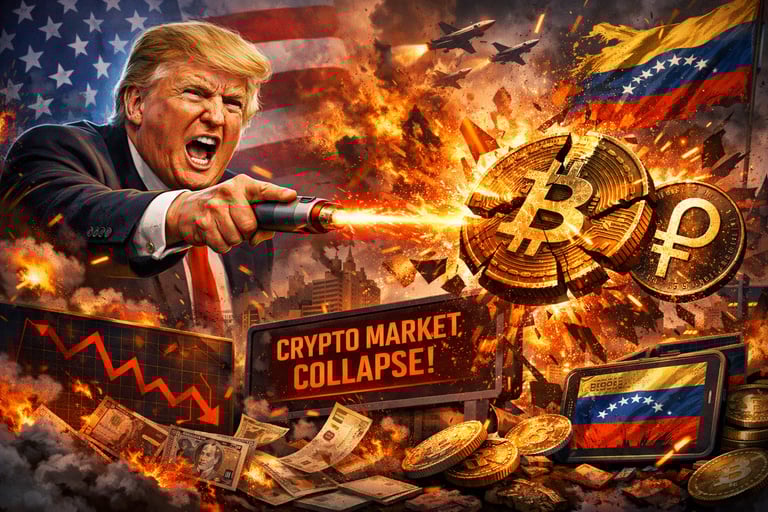
Trump Attacks Venezuela: Why January 2026 Could Be a Nightmare for Crypto Markets
Trump’s January 2026 attack on Venezuela could create extreme volatility in crypto markets. This in-depth analysis explains how war, dollar strength, oil shocks, and liquidity stress may hurt Bitcoin and altcoins throughout January 2026.
CRYPTO NEWS
1/3/20264 min read
Introduction: A Dangerous Start to 2026 for Crypto
January 2026 began with a geopolitical shock that instantly rattled global markets. The United States, under President Donald Trump, launched direct military action against Venezuela, escalating tensions in an already fragile global environment.
While traditional media focuses on political consequences, the crypto market faces a different and potentially more dangerous reality.
Bitcoin, Ethereum, and altcoins are entering January 2026:
At historically high price levels
With elevated leverage in derivatives markets
During a period of tightening global liquidity
Amid growing macroeconomic uncertainty
When military conflict collides with fragile market structure, crypto often reacts faster and more violently than any other asset class.
This article explains why Trump’s attack on Venezuela could make January 2026 a nightmare for crypto markets, especially for traders who underestimate macro risk.
1. War Instantly Shifts Markets Into Risk-Off Mode
The first and most powerful effect of military conflict is fear.
Markets don’t wait for long-term outcomes. They react immediately to uncertainty. When war breaks out, investors rush to:
Reduce exposure
Close leveraged positions
Move capital into safer assets
Crypto sits at the extreme end of the risk spectrum.
Despite being labeled “digital gold,” Bitcoin still behaves like a high-volatility risk asset during sudden global shocks. In moments of panic, traders do not debate philosophy—they sell what they can sell quickly.
Why Crypto Gets Hit First
Crypto trades 24/7
Liquidity is instantly accessible
Leverage is widespread
Stop-loss cascades trigger rapidly
In January 2026, this risk-off reflex is amplified by already elevated market positioning.
2. Bitcoin Is Not Immune During Initial Geopolitical Shocks
Many crypto investors believe Bitcoin thrives during chaos. This belief is partially true, but dangerously misunderstood.
Historically, Bitcoin does not rally during the initial phase of geopolitical conflict. Instead:
It often falls alongside equities
It suffers from forced liquidations
It declines as traders raise cash
Only after markets stabilize does the “hedge narrative” sometimes emerge.
January 2026 Reality
At the moment of Trump’s Venezuela attack, Bitcoin is:
Highly liquid
Heavily traded
Widely used as collateral
This makes it a source of liquidity, not a safe haven, during the first phase of crisis.
3. U.S. Dollar Strength Is Bad for Crypto
Military conflict involving the United States almost always strengthens the U.S. dollar.
Global capital reacts by:
Seeking safety
Holding dollar-denominated assets
Reducing exposure to volatile markets
For crypto, this is a major problem.
Dollar Strength vs Crypto
Strong USD tightens global liquidity
Tighter liquidity reduces speculative appetite
Bitcoin and altcoins struggle to maintain momentum
Crypto markets rely heavily on excess global liquidity. When the dollar strengthens, that excess disappears.
January 2026 already carries uncertainty around monetary policy. A war-driven dollar surge could intensify pressure on crypto prices.
4. Oil Shock Adds Inflation Fear and Rate Pressure
Venezuela is a major oil producer. Any military action involving energy-producing regions raises fears of:
Supply disruptions
Shipping risk
Sanctions escalation
Rising oil prices create inflation anxiety.
While some argue that inflation helps Bitcoin, the short-term effect is often bearish.
The Chain Reaction
Oil prices rise
Inflation expectations increase
Central banks stay hawkish
Interest rates remain high
Liquidity tightens
Crypto markets sell off
Bitcoin benefits from inflation only when money is easy. War-driven inflation combined with tight policy is a toxic mix.
5. Liquidity Is the True Lifeblood of Crypto Markets
Crypto does not move on belief alone. It moves on liquidity.
War damages liquidity by:
Freezing institutional capital
Increasing uncertainty
Raising risk premiums
Institutions reduce exposure first—and crypto is one of the easiest markets to exit.
Why January 2026 Is Fragile
Large futures open interest
High retail participation
Algorithmic trading dominance
When liquidity contracts, crypto markets experience:
Flash crashes
Violent wicks
Exchange instability
Trump’s Venezuela attack significantly increases the probability of such events.
6. Leverage Turns Small Shocks Into Big Crashes
Crypto markets run on leverage.
During calm periods, leverage fuels gains. During crises, it fuels destruction.
What Happens During Geopolitical Panic
Price moves trigger liquidations
Liquidations create forced selling
Forced selling accelerates downside
Downside triggers more liquidations
This feedback loop can turn a modest sell-off into a sharp crash within hours.
In January 2026, leverage magnifies the damage of any macro shock.
7. Stablecoins Absorb Capital Before Bitcoin Does
A critical misunderstanding among crypto traders is assuming all crisis capital flows into Bitcoin.
In reality, it flows into stablecoins first.
During geopolitical stress, traders want:
Stability
Flexibility
Optionality
Stablecoins offer all three.
The Typical Crisis Flow
War or shock occurs
Volatile assets are sold
Capital moves into stablecoins
Bitcoin demand weakens temporarily
This means even within crypto, Bitcoin can underperform during fear-driven periods.
8. Altcoins Are the Biggest Casualties
If Bitcoin struggles, altcoins struggle much more.
Altcoins depend on:
Speculation
Narrative momentum
Excess liquidity
War destroys all three.
Likely Altcoin Outcomes in January 2026
Deep percentage drawdowns
Illiquid order books
Failed rallies
Long recovery times
Low-cap and narrative-driven tokens face the highest risk.
9. Regulatory Pressure Can Increase During Conflict
Geopolitical conflict often leads governments to:
Increase financial monitoring
Tighten compliance
Scrutinize cross-border flows
Crypto naturally attracts attention due to its global nature.
Even without new laws, fear of regulation alone can:
Reduce institutional participation
Delay investment decisions
Weigh on market sentiment
January 2026 could see heightened caution across exchanges and on-ramps.
10. Bitcoin Correlates With Macro Stress in the Short Term
Bitcoin is often uncorrelated in the long run—but not in crises.
During acute stress:
Bitcoin correlates with equities
Correlation spikes across risk assets
Diversification temporarily disappears
This is exactly when traders expect Bitcoin to “decouple”—and are disappointed when it doesn’t.
January 2026 is about short-term stress, not long-term narratives.
11. January Is Already a Volatile Month for Crypto
January brings:
Portfolio rebalancing
Tax-related selling
New-year positioning
Thin liquidity
Adding a military conflict turns an already volatile month into a dangerous one.
What This Means
More fake breakouts
More emotional trading
More losses for overconfident traders
Trump’s Venezuela attack amplifies all January weaknesses.
12. Psychological Fear Dominates Market Narratives
Markets move on stories, not spreadsheets.
In January 2026, the dominant stories may be:
War escalation
Oil instability
Dollar strength
Global uncertainty
These narratives suppress risk-taking behavior.
Even long-term Bitcoin believers often reduce exposure temporarily, adding to selling pressure.
What Crypto Traders Should Expect in January 2026
This environment does not mean crypto is finished. It means:
Volatility will be extreme
Direction will be uncertain
Risk management will matter more than prediction
Traders should expect:
Faster liquidations
Larger intraday swings
Strong macro correlation
This is a market that punishes leverage and rewards discipline.
Long-Term vs Short-Term Reality
Long term, Bitcoin may benefit from:
Financial fragmentation
Currency instability
Declining trust in traditional systems
Short term, however, war is bearish.
January 2026 is about:
Liquidity stress
Fear-driven positioning
Macro dominance
Confusing long-term belief with short-term price action is one of the most expensive mistakes traders make.
Final Verdict
Trump’s January 2026 attack on Venezuela introduces severe macro risk at a fragile moment for crypto markets.
The biggest threats are:
Risk-off sentiment
Dollar strength
Liquidity contraction
Leverage-driven crashes
This does not mark the end of crypto—but it raises the probability of a painful January 2026.