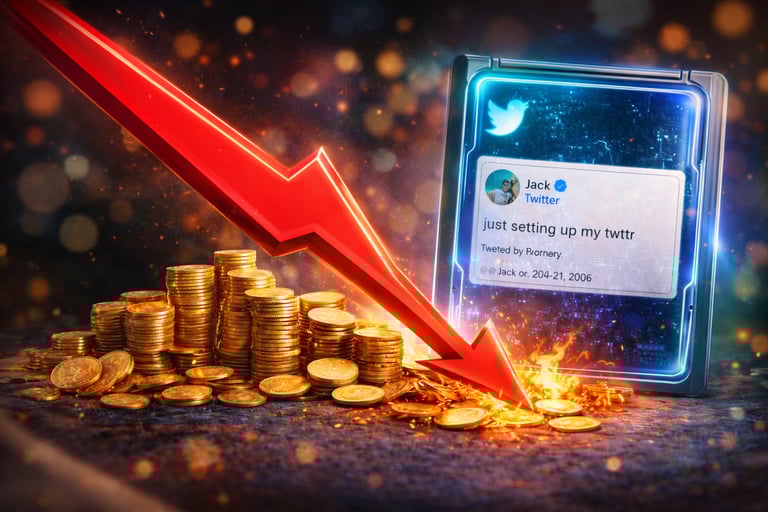
Twitter’s $2.9 Million NFT That Became Almost Worthless The Rise and Brutal Fall of a Digital Tweet
Twitter’s first-ever tweet sold for $2.9 million at the peak of the NFT boom. It was hailed as a historic moment in digital ownership. Just a year later, bids struggled to cross a few thousand dollars. How did a viral crypto trophy collapse so fast? Here’s the full story behind one of the most shocking NFT crashes.
CRYPTO NEWS
2/20/20264 min read
The Tweet That Made History
In March 2021, during the peak of NFT mania, something unexpected happened.
The very first tweet ever posted on Twitter — written by co-founder Jack Dorsey — was sold as an NFT for $2.9 million.
The tweet read:
“just setting up my twttr”
Simple. Casual. Historic.
It was minted and auctioned via the NFT platform Valuables by Cent, and eventually purchased by crypto entrepreneur Sina Estavi.
At that moment, it felt revolutionary.
The world was told:
Tweets can be owned.
Digital history can be tokenized.
Blockchain proves authenticity forever.
It wasn’t just a tweet.
It was framed as the birth certificate of social media.
Why Did Someone Pay $2.9 Million for a Tweet?
To understand the crash, you must first understand the mindset of 2021.
1. Peak NFT Euphoria
In early 2021:
NFT volumes were exploding.
Celebrities were minting digital collectibles.
Crypto markets were booming.
Retail investors were chasing fast gains.
Earlier that same month, digital artist Beeple had sold his artwork for $69.3 million at Christie's.
NFTs were the hottest narrative on the internet.
Paying millions for a tweet didn’t seem insane in that environment.
It seemed visionary.
2. The Illusion of Scarcity
The tweet itself was publicly visible. Anyone could screenshot it.
But the NFT represented:
A blockchain certificate
A digital signature
Proof of ownership
This created artificial scarcity.
In reality, millions could view the tweet.
But only one person could own “the token.”
That subtle psychological difference drove bidding wars.
3. Status Signaling
Owning the first tweet on Twitter was more than digital art.
It was:
A flex.
A status symbol.
A historical crypto trophy.
Just like someone might pay millions for a rare baseball card, this was positioned as the ultimate piece of internet history.
The Buyer: Sina Estavi
The winning bidder was Iranian crypto entrepreneur Sina Estavi.
At the time, he called the NFT the “Mona Lisa of the digital world.”
That statement perfectly captured the mindset of the era.
Crypto wealth was booming.
Risk appetite was extreme.
Speculation felt unstoppable.
But markets do not move in straight lines forever.
The Collapse Begins
In 2022, the crypto market reversed sharply.
Bitcoin crashed.
Ethereum fell dramatically.
NFT trading volume collapsed by over 90% across marketplaces.
Speculative liquidity evaporated.
And then came the shocking moment.
Estavi tried to resell the NFT.
He listed it with expectations of making tens of millions in profit.
The highest bid?
Reportedly under $15,000 at one point.
From $2.9 million to offers barely crossing four figures.
That is a collapse of over 99%.
What Went So Wrong?
Let’s break it down logically.
1. Zero Intrinsic Utility
The NFT did not generate:
Cash flow
Royalties
Access benefits
Community privileges
It was purely symbolic.
When speculation faded, there was no fundamental support.
2. Liquidity Crisis
High-value NFTs require:
Wealthy buyers
Strong market confidence
Active speculative demand
In bear markets, buyers disappear.
Illiquid assets collapse the fastest.
3. Narrative Collapse
In 2021:
NFTs = Future of digital ownership.
In 2022:
NFTs = Symbol of speculative excess.
Narratives drive markets more than fundamentals.
When the story changes, valuation follows.
The Psychology Behind the Crash
The Twitter NFT collapse is a textbook case of behavioral finance.
Fear of Missing Out (FOMO)
Investors saw massive NFT flips happening daily.
No one wanted to miss the next big thing.
So bids escalated irrationally.
Greater Fool Theory
Many NFT buyers believed:
“I can sell this later for more.”
This works only as long as new buyers enter the system.
Once demand slows, prices collapse dramatically.
Social Proof
When public figures, celebrities, and institutions participate, skepticism decreases.
But social validation does not guarantee long-term value.
The Broader NFT Market Crash
The tweet NFT was not alone.
Across the NFT ecosystem:
Blue-chip collections dropped 70–95%.
Trading volume dried up.
New mint hype vanished.
NFTs that once sold for six figures struggled to attract bids at a few thousand dollars.
Speculation had outrun utility.
When liquidity tightened globally due to rising interest rates and macro uncertainty, risk assets suffered.
NFTs were the most fragile layer of the risk pyramid.
Is the Tweet NFT Truly Worthless?
Technically, it is not worthless.
It still exists on the blockchain.
It still represents ownership of the first tweet’s NFT certificate.
But value is determined by what someone is willing to pay.
And at current market conditions, buyers are unwilling to pay anything close to millions.
This is the harsh reality of speculative markets.
Past price does not equal present value.
Lessons Every Investor Should Learn
The fall of Twitter’s NFT offers powerful lessons.
1. Hype Is Not Value
Just because something is trending does not mean it has sustainable demand.
2. Liquidity Drives Price
When money is abundant, speculative assets soar.
When liquidity dries up, they crash.
3. Illiquid Assets Are Dangerous
Luxury collectibles, NFTs, rare items — they depend on narrow buyer pools.
In downturns, that pool shrinks fast.
4. Peak Sales Often Mark Market Tops
The $2.9 million purchase happened at the height of NFT mania.
Extreme transactions often signal euphoria peaks.
Could It Ever Recover?
It’s possible — but unlikely in the near term.
For a significant rebound, the market would need:
A new crypto supercycle
Renewed NFT enthusiasm
Institutional validation
Strong liquidity conditions
Markets are cyclical.
But assets that peak during hype cycles rarely revisit those highs quickly.
Some never do.
The Irony of Digital Ownership
The tweet still exists on Twitter (now rebranded as X).
Anyone can view it for free.
The NFT owner does not control the tweet.
They cannot delete it.
They cannot restrict access.
They simply own a blockchain token referencing it.
This realization weakened perceived value over time.
Ownership without control reduces practical worth.
NFT Mania in Retrospect
Looking back, the NFT boom followed a classic bubble structure:
Innovation (blockchain, digital art)
Early adopters profit
Media frenzy
Celebrity endorsements
Extreme price acceleration
Retail FOMO
Liquidity peak
Collapse
The Twitter NFT was caught near stage five or six.
When markets reverted, the drawdown was brutal.
The Bigger Picture
The crash does not mean blockchain technology failed.
It means speculative pricing overshot rational demand.
The internet often confuses innovation with immediate value.
True value takes time to develop.
Speculation tries to skip that process.
When reality arrives, prices adjust violently.
Final Takeaway
Twitter’s $2.9 million NFT becoming almost worthless is not just a crypto story.
It is a story about:
Human psychology
Liquidity cycles
Market excess
Hype-driven valuation
Speculative markets can create extraordinary price spikes.
But without fundamentals, those spikes are fragile.
The next time you see an asset skyrocket because “it’s the future,” pause.
Ask:
Who will buy this from me later?
What real utility supports this price?
Is this innovation — or euphoria?
Because history shows that when euphoria fades, corrections are not gentle.
They are violent.
And sometimes, they erase over 99% of value.