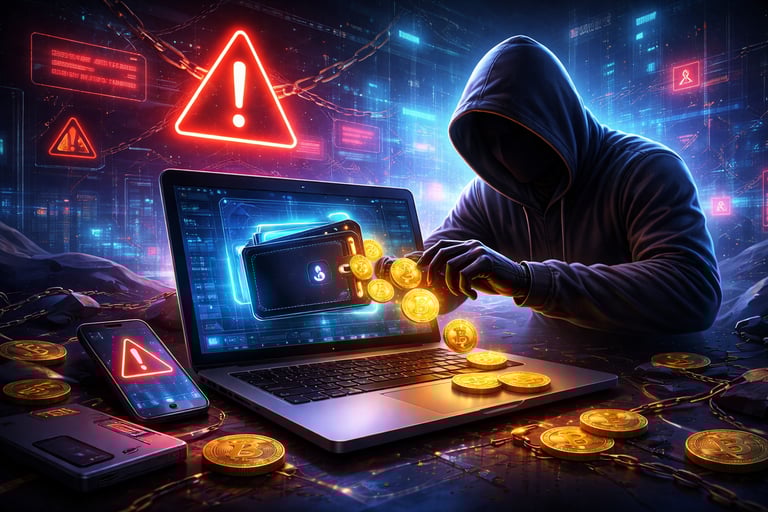
What to Do If Your Crypto Is Stolen in 2026 – Step-by-Step Recovery Guide by DropFinder
What to Do If Your Crypto Is Stolen in 2026? Learn exactly what to do next, how to secure funds, report theft, and protect yourself in the future. A complete DropFinder recovery guide.
CRYPTO NEWS
1/20/20264 min read
Introduction: When Crypto Theft Becomes Personal
Losing cryptocurrency is not just about losing money. In 2026, crypto represents savings, dreams, years of patience, and belief in a decentralized future. When that crypto is stolen, the pain feels personal. Your heart races, your mind freezes, and one question keeps repeating: Is it gone forever?
Crypto theft has evolved rapidly. Hackers are no longer random amateurs. They run professional operations, use psychological manipulation, exploit smart contracts, and take advantage of human trust. Even experienced users are falling victim.
If your crypto has been stolen, this guide is written for you. Not with fake promises, not with unrealistic recovery claims, but with clarity, honesty, and real-world steps that actually matter in 2026.
This is not theory. This is survival.
Step One: Slow Down and Confirm What Actually Happened
The worst mistake after crypto theft is panic. Panic causes rushed decisions, and rushed decisions often lead to further losses.
Before doing anything, confirm the situation clearly.
Check your wallet transaction history carefully. Did the transaction leave your wallet without your action? Did you unknowingly approve a smart contract? Did only one token disappear, or was the wallet fully drained?
In 2026, many losses happen because users confuse authorized drains with hacks. If you signed a malicious approval, the blockchain still considers it valid, even if you were tricked.
Understanding how the crypto was stolen will decide what you should do next.
Common Ways Crypto Gets Stolen in 2026
Crypto theft is no longer limited to simple phishing emails. The methods are far more advanced now.
Fake wallet update websites that look identical to official ones
Malicious smart contract approvals hidden behind simple clicks
Fake airdrops and NFT mints designed to drain wallets
Compromised browser extensions
SIM swap attacks targeting exchange accounts
Malware that replaces copied wallet addresses
Sponsored ads linking to fake DeFi platforms
Recognizing the attack method helps prevent repeating the same mistake again.
The First 60 Minutes: What You Do Here Matters the Most
The first hour after discovering theft is critical.
Immediately disconnect your wallet from all websites. Close browser tabs. Do not click anything else.
If the wallet still has funds, move them immediately to a brand-new wallet created on a clean device. Never reuse the compromised wallet again.
Change passwords for your email first, then exchanges, then social media. Enable two-factor authentication everywhere.
If you suspect malware, stop using that device completely. Logging in again could expose fresh wallets too.
Time is your only advantage. Hackers move fast, but sometimes they make mistakes.
Why You Must Never Trust the Compromised Wallet Again
Many users believe that once funds are gone, the wallet is “empty and safe.” This is dangerous thinking.
In 2026, delayed drain attacks are common. Hackers leave small amounts behind and return later. Some malicious contracts activate only when balances increase.
Once a wallet is compromised, it is dead. Emotionally detach from it and move on.
Your security mindset must be ruthless.
Revoking Smart Contract Permissions Is Non-Negotiable
Most modern crypto theft happens without private keys being stolen. It happens through approvals.
When you interact with DeFi platforms, NFT mints, or token swaps, you often grant permissions. Malicious contracts exploit this.
Revoke all permissions immediately after theft. Not just the suspicious ones—everything.
This single step has saved thousands of users from repeated wallet drains.
Tracking Stolen Funds: Transparency Is Your Ally
One of crypto’s biggest strengths is also your investigative tool: the blockchain never lies.
Track the transaction hash. Watch where the funds go. Do they move to an exchange? Are they bridged? Are they split into smaller transactions?
This information matters.
If funds reach centralized exchanges, there is a small but real chance of freezing them if action is taken fast.
Without tracking, you are blind.
Contacting Exchanges: Speed Over Emotion
If stolen crypto touches a centralized exchange, contact them immediately.
Provide only facts:
Transaction hash
Wallet addresses
Exact timestamps
Type of asset stolen
Do not write emotional messages. Exchanges respond to precision, not panic.
In 2026, many exchanges cooperate with cybercrime units. But delays kill chances.
Minutes matter. Hours reduce odds. Days usually end hope.
Filing a Cybercrime Report Still Matters
Many victims avoid reporting theft because they think nothing will happen. This is a mistake.
A cybercrime report creates an official record. It helps exchanges act. It supports legal action. It can be useful for tax loss claims.
Crypto regulation in 2026 is far more mature than people realize. Reports are not useless—they are documentation.
Even if recovery does not happen, protection of your future does.
Beware of the Second Scam: Fake Recovery Services
After theft, victims are emotionally vulnerable. Scammers know this.
Anyone promising guaranteed recovery is lying. Anyone asking for private keys is stealing again. Anyone demanding upfront fees is exploiting pain.
In 2026, “crypto recovery experts” are one of the fastest-growing scam categories.
No ethical professional will guarantee blockchain reversal. Be ruthless in skepticism.
Emotional Damage Is Real and Must Be Addressed
Crypto loss hurts deeply. Many victims feel shame and avoid talking about it. Some spiral into reckless trading to “win it back.”
This is dangerous.
Accept the loss first. Take a pause. Clear thinking is impossible when emotions dominate.
Crypto rewards discipline, not revenge.
Learning the Exact Mistake That Led to Theft
Recovery begins with understanding.
Was it a fake link? A sponsored ad? A rushed approval? A moment of greed? A lack of verification?
Write it down. Study it. Burn it into memory.
Most repeat victims fail not because of lack of intelligence, but because they never fully understand what went wrong the first time.
Rebuilding Security Like a Professional
In 2026, casual security is not enough.
Use hardware wallets for long-term storage. Separate wallets for DeFi and storage. Never store large funds in hot wallets.
Use a dedicated browser or device only for crypto. Avoid extensions. Avoid unnecessary interactions.
Security is not paranoia. It is professionalism.
Portfolio Monitoring and Instant Alerts
Modern wallet drain attacks can happen silently in seconds.
Use monitoring tools that alert you instantly when funds move. Early alerts are sometimes the only reason funds are saved.
Silence is the enemy.
Rebuilding After Loss: Slow Is Strong
Trying to recover losses quickly often leads to bigger mistakes.
Rebuild slowly. Focus on learning. Stick to verified platforms. Avoid leverage until emotional balance returns.
Many of today’s strongest crypto investors are survivors of past losses. What separated them from permanent failure was discipline.
Why Awareness Platforms Like DropFinder Matter
Most crypto losses start with exposure to fake opportunities.
Platforms like DropFinder focus on identifying real opportunities while filtering out noise, scams, and fake hype. Staying informed reduces risk dramatically.
Information is security.
The Hard Truth About Crypto in 2026
Crypto gives freedom, but freedom has no safety net.
There is no customer care. No chargebacks. No mercy.
But there is transparency. There is education. There is growth through mistakes.
Survivors are not lucky. They are disciplined.
Final Thoughts: Loss Is Not the End
If your crypto was stolen, you are not weak. You are human in a system that punishes small mistakes brutally.
What defines you is not the loss, but what you do next.
Learn. Secure. Rebuild.
The journey continues.