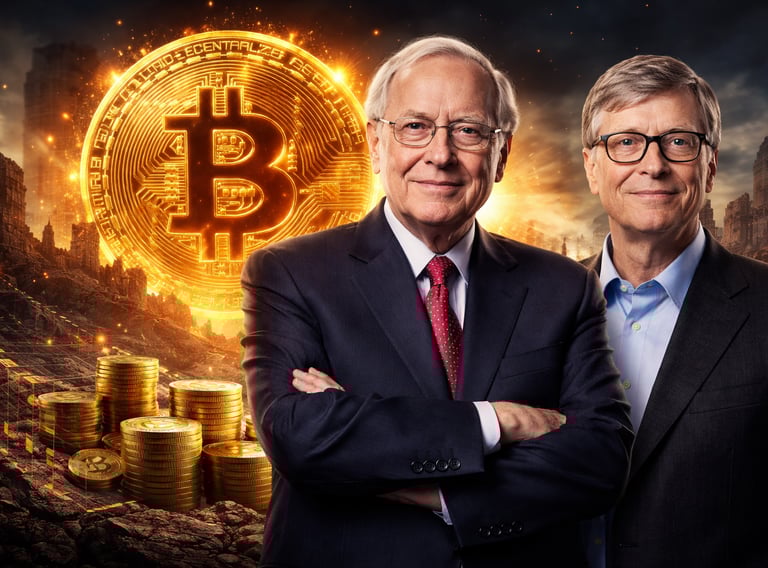
Why Bill Gates and Warren Buffett Still Refuse to Buy Bitcoin in 2026 — The Truth Most Crypto Influencers Won’t Tell You
Why do Bill Gates and Warren Buffett Still Refuse to Buy Bitcoin in 2026 while institutions pile in? Discover the real reasons behind their refusal — risks, philosophy, valuation, and what smart crypto investors must understand today.
CRYPTO NEWS
1/24/20263 min read
Introduction: The Billion-Dollar Question That Refuses to Die
Bitcoin crossed multiple market cycles, survived government crackdowns, ETF battles, exchange collapses, and regulatory wars. By 2026, it is no longer a fringe experiment — it is discussed in central banks, pension funds, and global macro forums.
Yet one question continues to dominate crypto debates:
Why are Bill Gates and Warren Buffett — two of the world’s most successful investors — still not buying Bitcoin in 2026?
This question is not just about personal preference. It strikes at the core of investment philosophy, asset valuation, risk perception, and generational wealth thinking.
In this in-depth DropFinder analysis, we break down:
Their exact reasoning
Why their views have not changed
What they understand that most retail crypto investors ignore
Whether their stance makes Bitcoin weaker — or stronger
This article is not anti-Bitcoin. It is pro-understanding.
Who Are We Talking About?
Before analysis, clarity matters.
Bill Gates
A technologist, philanthropist, and long-term systems thinker. His wealth was built by creating productivity, not speculation.Warren Buffett
The most successful value investor in history, known for buying businesses with predictable cash flows.
Both men fully understand technology and markets. Their rejection of Bitcoin is not ignorance — it is deliberate.
Reason #1: Bitcoin Produces No Cash Flow — And That Is a Deal Breaker
At the heart of Buffett’s refusal lies a simple principle:
“If it doesn’t produce anything, I don’t know how to value it.”
Bitcoin:
Pays no dividends
Generates no earnings
Has no balance sheet
Has no management or cash flow
Buffett invests in productive assets — companies that generate profits year after year.
To him, Bitcoin is:
A non-productive asset
Entirely dependent on what the next buyer will pay
From his framework, Bitcoin resembles speculation, not investment.
Reason #2: Bill Gates Sees Bitcoin as “Pure Speculation,” Not Innovation
Bill Gates has never denied blockchain’s usefulness. In fact, he has praised:
Distributed ledgers
Digital identity systems
Financial inclusion tools
But Bitcoin is different in his view.
Gates’ concern is simple:
Bitcoin does not improve productivity
It does not create new economic output
It does not solve core human problems like healthcare, climate, or education
From Gates’ lens, innovation must:
Reduce costs
Improve efficiency
Create measurable value
Bitcoin, in his eyes, fails all three.
Reason #3: Volatility Is a Feature for Traders — A Bug for Wealth Preservers
By 2026, Bitcoin volatility has reduced compared to early years — but it is still extreme by traditional standards.
For Buffett and Gates:
Capital preservation > capital multiplication
Stability > explosive upside
A 30–50% drawdown:
Is acceptable for traders
Is unacceptable for custodians of generational wealth
Their capital is not chasing alpha. It is protecting legacy.
Reason #4: Bitcoin Relies on Belief, Not Intrinsic Value
Buffett famously said:
“Bitcoin doesn’t produce anything. You’re hoping someone else pays more.”
This highlights a core issue:
Bitcoin has no intrinsic valuation model
Price is driven by:
Narrative
Scarcity belief
Network effects
For Gates and Buffett, belief-based assets are dangerous because:
Belief can shift overnight
Regulation can change narratives
Technology can be replaced
They prefer assets whose value exists independent of belief.
Reason #5: Regulatory Uncertainty Still Exists in 2026
Despite ETFs, legal clarity is still uneven globally.
Concerns include:
Government bans
Self-custody restrictions
Surveillance requirements
Tax complications
For billionaires with public exposure:
Regulatory risk is reputational risk
Compliance uncertainty is unacceptable
Bitcoin may survive regulation — but they prefer assets that do not require survival.
Reason #6: Energy and ESG Conflicts Matter to Gates
Bill Gates has heavily invested in:
Climate solutions
Clean energy
Sustainability research
Bitcoin mining’s energy footprint remains controversial despite improvements.
Even if renewable mining grows, perception matters.
For Gates:
Optics + ethics > returns
Bitcoin contradicts his ESG alignment
Reason #7: They Do Not Need Bitcoin’s Asymmetric Upside
This is the most misunderstood point.
Bitcoin’s appeal is asymmetric risk:
Limited downside (in theory)
Massive upside (in bull cycles)
But Buffett and Gates already won the game.
They do not need:
10x gains
Moon cycles
Volatility-driven wealth
They need:
Stability
Influence
Long-term systemic impact
Bitcoin offers none of these directly.
Does Their Refusal Mean Bitcoin Is a Bad Investment?
Absolutely not.
Their refusal means:
Bitcoin does not fit their framework
Not that Bitcoin lacks value
In fact, Bitcoin thrives because:
Retail adoption exists
Institutions diversify
Sovereign risk hedging continues
Bitcoin is:
A hedge against monetary debasement
A tool for capital sovereignty
A parallel financial system
But it is not a value investment in the Buffett sense.
Why Crypto Twitter Misrepresents Their Views
Influencers often claim:
“They don’t understand Bitcoin”
“They’re too old”
“They missed the opportunity”
This is false.
They understand Bitcoin perfectly.
They simply reject its assumptions.
Disagreement does not equal ignorance.
What Smart Crypto Investors Should Learn From This
Instead of mocking them, learn:
Know why you own Bitcoin
Do not rely on narratives alone
Understand your risk tolerance
Separate speculation from conviction
Have an exit and custody plan
Bitcoin rewards discipline — not blind belief.
DropFinder Perspective: Bitcoin Needs Critics to Mature
At DropFinder, we track:
Airdrops
New chains
Token incentives
Market narratives
Bitcoin’s strength lies in:
Surviving criticism
Enduring skepticism
Adapting to opposition
If everyone agreed on Bitcoin, it would already be fully priced in.
Final Verdict: Two Worlds, Two Philosophies
Bill Gates and Warren Buffett are not anti-crypto.
They are anti-unproductive speculation.
Bitcoin is not meant to replace:
Businesses
Cash flows
Value investing
It is meant to:
Challenge fiat assumptions
Offer financial sovereignty
Exist outside traditional systems
Both truths can coexist.
Conclusion: The Real Question You Should Ask
The real question is not:
“Why aren’t Bill Gates and Warren Buffett buying Bitcoin?”
The real question is:
“Why am I buying Bitcoin — and do I truly understand it?”
If you do, their refusal should not shake you.
If you don’t, their caution should.