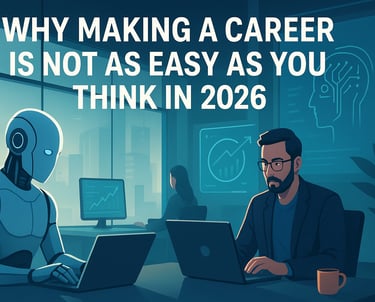
Why Making a Career Is Not as Easy as You Think in 2026 – The Harsh Truth Behind Modern Hustle”
In 2026, building a successful career has become more complex than ever. Discover why competition, AI automation, skill shifts, and economic realities make career growth harder — and how platforms like DropFinder help you stay ahead in the evolving professional landscape.
CRYPTO NEWS
10/22/20255 min read
Introduction: The Myth of the Easy Career Path
In the digital age, everyone dreams of success — to build a strong career, earn stability, and enjoy freedom. The internet is full of gurus preaching “easy ways” to achieve professional success. But in 2026, the truth is different. Making a career — whether in tech, finance, content creation, crypto, or entrepreneurship — is harder than it’s ever been.
Global competition, rapid automation, and a fast-evolving job market mean you’re not just working hard — you’re fighting against an intelligent, shifting system. What worked in 2016 or even 2021 no longer works today. The rules of the career game have changed.
Let’s uncover why making a career in 2026 is not as easy as it looks, and what you can do to survive and thrive — with the help of data-backed insights from DropFinder, one of the most reliable trend analysis tools for digital professionals.
1. The Market Has Become Oversaturated
Ten years ago, being “skilled” was enough. Today, millions of people have the same skills — coding, design, marketing, writing, or trading. The rise of online courses, freelancing platforms, and AI tools has flooded the market with similar talent.
Why it’s harder now:
Every skill can be learned online, making differentiation tough.
Global competition: You’re not just competing locally; you’re competing with the world.
AI tools like ChatGPT, Midjourney, and Jasper are replacing many entry-level jobs.
Example:
A decade ago, a web designer could charge $500 for a website. Now, with AI site builders and platforms like Wix and Framer, that same work might pay less than $100.
Insight from DropFinder:
Data shows a 42% increase in job listings requiring multi-domain expertise (e.g., “designer + marketer” or “developer + AI prompt engineer”). The single-skill era is over — you need hybrid skills to stand out.
2. AI Is Changing the Nature of Work
AI is no longer just a buzzword — it’s a job disruptor. From finance and content creation to logistics and healthcare, automation is reshaping industries. While AI creates opportunities, it also replaces repetitive and predictable roles.
Impact in 2026:
45% of traditional administrative roles have been automated.
AI-assisted marketing, trading, and data analysis tools have reduced demand for entry-level analysts.
Even creative fields like video editing, blogging, and illustration are being transformed by AI software.
Reality check:
If you’re not learning how to use AI, it’s already replacing you.
DropFinder Report 2026:
According to DropFinder’s 2026 “Future Skills Outlook,” AI fluency (understanding, using, and adapting AI tools) has become one of the top 3 skills for employability.
3. The Gig Economy Trap
Freelancing and remote work once promised freedom. But in 2026, the gig economy is oversaturated, underpaid, and unstable. Platforms like Fiverr, Upwork, and Freelancer have millions of users — making it a race to the bottom.
Common problems freelancers face:
Price wars and unrealistic client expectations.
Late payments and unstable income.
High competition with AI-generated services (e.g., AI content or logo design).
Even though remote work has increased, sustainable career growth in freelancing requires reputation, specialization, and consistent personal branding — all of which take years.
DropFinder’s insight:
Freelancers who specialized in AI-related services or Web3 projects in 2025 earned 63% more on average than those offering traditional services.
4. Cost of Living and Education Are Rising
While digital technology grows, so does the cost of living and skill-building. The average online certification or upskilling course costs 3x more than it did in 2020. Combine that with housing, healthcare, and inflation — and most professionals are struggling to save.
Why it matters:
A “career” today demands constant reinvestment. Whether it’s new tools, courses, or certifications, you must keep upgrading to stay relevant — which isn’t cheap.
DropFinder Trend Watch 2026:
Career costs are rising faster than average salaries, with an 18% skill inflation rate — meaning you must spend more to maintain your career value.
5. Mental Burnout and Overhustle Culture
Everyone is hustling. Social media glamorizes success stories but hides the anxiety, burnout, and exhaustion behind them. The pressure to “stay productive” 24/7 makes real career growth mentally draining.
Key reasons for burnout:
Constant social media comparison.
Unrealistic productivity standards.
Lack of work-life balance in remote jobs.
In 2026, the idea of “work-life harmony” has become harder to achieve, as most workers feel they’re always on call.
DropFinder Report (Career Wellness 2026):
Over 67% of digital professionals report chronic burnout symptoms. Only 12% say they feel “in control” of their career pace.
6. The Shift from Degrees to Skills — But Not Everyone Is Ready
The job market no longer values degrees as much as practical skills. However, the transition is uneven — many people are still stuck in outdated educational paths, while industries demand fast adaptability.
The problem:
Traditional education doesn’t teach adaptability or real-world skills.
People with degrees but no hands-on project experience struggle to find jobs.
Employers now prefer self-taught candidates with strong portfolios over paper qualifications.
DropFinder’s Education Index 2026:
Shows a 59% increase in employers prioritizing skill certificates or project portfolios over college degrees.
7. Economic Uncertainty and Career Volatility
Post-pandemic recovery, political instability, and global recessions have made job markets unstable. Entire industries — crypto, startups, and even big tech — are facing layoffs.
Example:
Tech layoffs in 2025 alone surpassed 450,000 across major firms, leaving thousands of skilled professionals without jobs.
DropFinder’s Market Data:
Forecasts another 3% decline in stable job openings by mid-2026, especially in non-technical sectors. The “safe job” no longer exists.
8. Career Success Now Depends on Personal Branding
In 2026, your career is not only what you do — it’s how you present it. Employers and clients look at your online presence before anything else.
Having a strong personal brand, portfolio, and digital footprint is now essential. But building that brand takes consistent effort — creating content, networking, and showcasing your achievements.
DropFinder Social Insight:
Professionals with active LinkedIn or X (Twitter) profiles receive 78% more offers than those without online visibility.
Reality:
It’s no longer about being the best — it’s about being visible.
9. The Fear of Missing Out (FOMO) Career Effect
With so many new fields — AI, Web3, DeFi, content creation, and remote startups — many professionals jump between industries, chasing trends. But switching too often dilutes expertise and creates instability.
Career FOMO traps:
Constantly trying to “pivot” to trending skills.
Leaving stable paths for uncertain hype projects.
Comparing progress with others online.
DropFinder Analysis:
Professionals who “pivoted” industries more than twice in three years earned 27% less on average than those who stayed consistent in one direction.
10. The Harsh Reality — Everyone’s Competing with Data
Every career path is now data-driven. Whether you’re a marketer, trader, or content creator, success depends on analytics and algorithms — not just talent.
Example:
Marketers rely on SEO and engagement analytics.
Traders depend on crypto data platforms like DropFinder for market trends.
Creators must optimize videos and posts based on algorithmic behavior.
Without understanding data, you’re navigating blind. Platforms like DropFinder give professionals a data edge — helping them track industry trends, audience insights, and emerging opportunities before others see them.
11. The Rise of the “AI-Human Hybrid Professional”
The successful professional of 2026 isn’t competing with AI — they’re collaborating with it. The modern career demands people who can combine human creativity with machine intelligence.
DropFinder Research:
Hybrid roles (like “AI Marketing Strategist” or “Data-driven Content Creator”) have seen a 110% growth in hiring demand from 2024–2026.
To survive, you must learn to:
Use AI tools efficiently.
Analyze data trends.
Adapt faster than algorithms.
12. How to Stay Ahead in 2026
Despite all these challenges, opportunity still exists for those who adapt smartly. Here’s how to future-proof your career:
✅ Use tools like DropFinder to identify market trends before they peak.
✅ Focus on multi-skill mastery (AI, analytics, creativity, and communication).
✅ Build a strong personal brand with digital visibility.
✅ Prioritize mental health and avoid toxic hustle culture.
✅ Treat AI as a partner, not a rival.
Conclusion: Reality Over Illusion
In 2026, making a career is not about luck or shortcuts — it’s about strategy, adaptability, and awareness. The world rewards those who learn faster, adapt to AI, and understand where the market is heading.
The career landscape is shifting daily, and while the old dream of “stability” may be gone, the new world offers limitless growth for those who evolve with it.
And with tools like DropFinder, you can stay ahead of the trends, understand data-driven opportunities, and build a career that thrives — not just survives — in 2026.